Peevish Pen

Ruminations on reading, writing, genealogy and family history, rural living, retirement, aging—and sometimes cats.

© 2006-2025 All rights reserved

My Photo
Name:
Location: Rural Virginia, Virginia, United States

I'm an elderly retired teacher who writes. Among my books are Ferradiddledumday (Appalachian version of the Rumpelstiltskin story), Stuck (middle grade paranormal novel), Patches on the Same Quilt (novel set in Franklin County, VA), Them That Go (an Appalachian novel), Miracle of the Concrete Jesus & Other Stories, and several Kindle ebooks.

Saturday, October 28, 2017

Desolate Places


October is a month of desolation, when we're aware—despite clear blue skies and bright colors—that the year is dying. Leaves fall; winds blow; the days grow shorter. Robert Frost captures the desolation in this poem:

Robert Frost

O hushed October morning mild,
Thy leaves have ripened to the fall;
Tomorrow’s wind, if it be wild,
Should waste them all.
The crows above the forest call;
Tomorrow they may form and go.
O hushed October morning mild,
Begin the hours of this day slow.
Make the day seem to us less brief.
Hearts not averse to being beguiled,
Beguile us in the way you know.
Release one leaf at break of day;
At noon release another leaf;
One from our trees, one far away.
Retard the sun with gentle mist;
Enchant the land with amethyst.
Slow, slow!
For the grapes’ sake, if they were all,
Whose leaves already are burnt with frost,
Whose clustered fruit must else be lost—
For the grapes’ sake along the wall.

On a few recent October mornings, I've noticed some of the desolation near me. Just down the road is what was once the old Wright farm, that was clear-cut a few years ago and then sprayed with herbicide. Remnants of the house, desolate and decaying, remain.


The barn, or what's left of it, is still there, too.


The long-dead Wrights still lie in their desolate, untended graves. I blogged about them in "What Was Once."


Several miles from this farm, on Brooks Mill Road, is an old building surrounded by woods. I'm not sure what it used to be, but I'm guessing a church. But it's pretty much abandoned—desolate in these October woods.


On the Sutherland planation, the skies show October's bright blue weather but the buildings are desolate and falling down.


This cabin, which once was the home of Civil War veteran William M. Sutherland, hasn't been lived in for nearly a century. October is coming to an end. The wild earth will go its way.


October seems to inspire poetry. Here's another October poem.


A Calendar of Sonnets
Helen Hunt Jackson

The month of carnival of all the year, 
When Nature lets the wild earth go its way, 
And spend whole seasons on a single day. 
The spring-time holds her white and purple dear; 
October, lavish, flaunts them far and near; 
The summer charily her reds doth lay 
Like jewels on her costliest array; 
October, scornful, burns them on a bier. 
The winter hoards his pearls of frost in sign 
Of kingdom: whiter pearls than winter knew, 
Oar empress wore, in Egypt's ancient line, 
October, feasting 'neath her dome of blue, 
Drinks at a single draught, slow filtered through 
Sunshiny air, as in a tingling wine! 


October is coming to an end. The wild earth will go its way.
~

Labels: , , ,

Friday, April 07, 2017

Lilacs and Connections


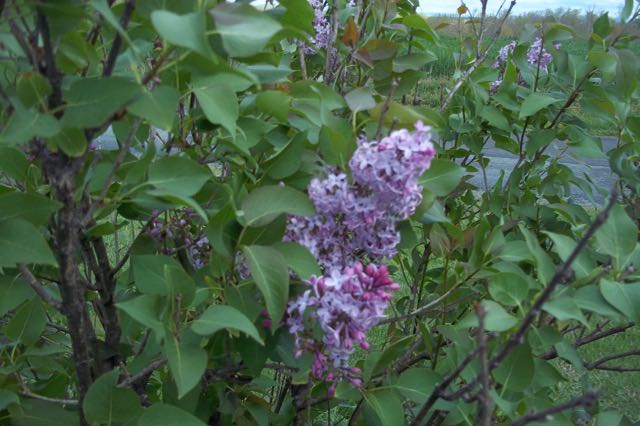
My lilac bush is blooming. Brought from a slip off the bush on Smith Farm, it is an old-timey lilac with a wonderful fragrance. The original lilac bush was planted by the old kitchen house near the cabin, but what's left of the kitchen has been just a pile of rocks for nearly a century.


My Aunt Belva—who died in 2003—once told me that when she was a child, she and her younger sister Virgie—who is 99—were playing in the old kitchen when it fell in. I'd always thought of the kitchen—and lilac—as my Granny Sallie's, but now I realize the kitchen was Gillie Ann Bernard's. It's likely Gillie Ann planted the lilac. Gillie Ann died in 1897 and was the first resident of the cemetery up on the hill. 


Her husband William had a window cut in the cabin wall so he could sit by the fireplace and see her grave. This window also provided a view of the lilac bush. William joined Gillie Ann on the hill in 1907. (I blogged about that cemetery in my "Vines and Stones" post in 2011 and again in 2014 in "Special Delivery.")


Until recently, I didn't know I had a connection to Gillie Ann, but it turns out that she's my first cousin. three times removed.  Here's how: Gillie Ann Bernard is the daughter of Gwin—or Gwynn—Dudley (1810-1846) and Nancy Eliza Smith (1815-1890). Nancy Eliza is the daughter of my 3rd-great-grandfather, John Wood Smith (?-1842), who lived just down the road apiece from where Smith Farm is. John Wood Smith was married to Lucy English (1791-abt. 1850), daughter of George Lewis English and Ann (Nancy) Smith, the daughter of Col. John Smith and his wife Frances. It is likely that Col. John Smith (1735-1820) is somehow kin to John Wood Smith, so Gillie and I might be kin in another way, too. All of these folks lived within a few miles of each other in Union Hall. 


Anyhow, Gillie Ann Dudley Bernard and my great-grandfather, Henry Silas Smith (1854-1923) are both grandchildren of John Wood Smith—and that's my connection. 


In long-ago Aprils, my distant cousin must have enjoyed the smell of lilac blossoms outside her kitchen door. Over a century later, I'm enjoying them too.
~

Labels: , , , , ,

Monday, January 09, 2017

Regional Reading

Recently, I've read three books about regional history—and I've learned a lot. All three were published in 2016; one was from a major publisher, two were self-published.


Beth Macy's Truevine (Little, Brown, & Company, 2016) is a best-seller (like her previous book, Factory Man) and has appeared on numerous "Best Books" lists. Macy, who used to write for The Roanoke Times, is a talented writer who does meticuous research. I used to enjoy her feature stories in the newspaper; I enjoyed this book as well.

The Truevine area is a few miles from where I live, but I'd never before heard the story of the two albino Muse brothers, George and Willie, who were kidnapped as children to appear in a circus sideshow. Subtitled, "Two Brothers, a Kidnapping, and a Mother's Quest: A True Story of the Jim Crow South," the book follows the brothers as they travel with the sideshow and when they are finally reunited with their mother (now in Roanoke)—and then travel again. Finally the Muse twins return to Roanoke to live out the remainder of their lives. Willie is over a hundred when he dies in 2001.

For years, their family didn't want the twins' story told, but Macy was able to win their confidence and get the story. Besides the story about the twins'travels and travails, there's also a lot of info about circus sideshows and the freaks that were exhibited and about black life in early Roanoke. I'm glad I read the book; it was an eye-opener. I highly recommend it.

100 Proof: The Untold Stories of Notorious Franklin County Moonshiner Amos Law was self-published by Henry Lee law, Amos Law's son. The book follows the exploits not only of Amos Law but also his son. This book was also an eye-opener. While I knew that moonshining was still alive and well in the county, I had no idea it was quite so close or so widespread.

This book, while hard to find if you live outside Franklin County, is well worth reading for its insights into local history and culture. Henry Lee Law gives a lot of specific info—and names names—but he doesn't give away his family recipe. Still (no pun intended), I highly recommend 100 Proof, which I originally heard about in an article Morris Stephenson wrote back in November for The Franklin News-Post: "Moonshine maker shares the good and bad of his profession."

Speaking of moonshine, Morris Stephenson is one of the two compilers of another moonshine-related book; local genealogist/historian Beverly Merritt is the other. Both had collections of newspaper clippings about a famous—or possibly infamous—moonshine conspiracy trial, but neither had a complete set. Combining what they had resulted in their self-published book,  Franklin County's Famous 1935 Moonshine Conspiracy Trial: Complete Daily Newspaper Daily Accounts.


The book's front and back covers contain pictures of some of the original news columns.


Since the anonymous stories from various regional newspapers are now in public domain, the book was a matter of transcribing the stories (so they're much easier to read than the original clippings) and putting them in chronolgical order. This provides a good look at what my grandparents and their contemporaries likely read—and how they kept track of what was happening in the courthouse.

With this compilation, Stephenson and Merritt have provided a handy historical record of what the reporters saw in the courtroom.
~

Labels: , ,

Tuesday, October 21, 2008

Shady Rest (in Fall)

This year's fall colors in my part of rural Virginia aren't as colorful as they might be. The other day, I took some pictures at the Brown Farm. (When the Browns owned it, they called it Shady Rest.) The colors in these pictures are muted, not vibrant. They're not far from looking like old, sepia-toned photographs of a by-gone era. The barn at Shady Rest was most likely built of lumber that my grandfather, Joe Smith, sawed at his sawmill up the road. The area has—or at least had— several barns identical to this. The house is falling in—victim of age, rot, termites, and weather. But from a distance, it still looks like a house. One of the big maples that long ago provided shade is dying. In the picture below, at the left, you can just barely see the shape of one of the sheds. now it's covered with Virginia creeper and poison oak. Three-quarters of a century ago, when Shady Rest was a working farm and home to the John Thomas Brown family, the shed looked like this: The man in the middle, Guy Brown (JT Brown's son) married Louise Mattox, my first cousin once removed, who lived not far away. She was the daughter of my Great-Aunt Tokay, the younger sister of Joe Smith. Guy and Louise lived in Roanoke, less than a mile from where I grew up. He worked for a Pontiac dealership on Williamson Road. When I graduated from college and secured a teaching job, I bought my first "new" car—a brand-new 1967 Firebird—from him. JTB, as an older man, stands by the corner of his house—the same house that appears in the first two photos on this entry. The house corner looks strong and sturdy and solid—as if it could last forever. As a young man, Brown was handsome. Here he is with three of his children: The house was handsome in its hey-day, too. But nothing lasts forever. Autumn's falling leaves are proof of that.
~ Thanks to Patricia Martin for providing the old photos.

Updated to add a copy of a painting of the house (artist unknown) that was done many years ago:


~

Labels: , , , ,