Peevish Pen

Ruminations on reading, writing, genealogy and family history, rural living, retirement, aging—and sometimes cats.

© 2006-2025 All rights reserved

My Photo
Name:
Location: Rural Virginia, Virginia, United States

I'm an elderly retired teacher who writes. Among my books are Ferradiddledumday (Appalachian version of the Rumpelstiltskin story), Stuck (middle grade paranormal novel), Patches on the Same Quilt (novel set in Franklin County, VA), Them That Go (an Appalachian novel), Miracle of the Concrete Jesus & Other Stories, and several Kindle ebooks.

Wednesday, November 08, 2023

Smith Farm History

Smith Farm has been in my family for over a hundred years and through three generations. 

On that farm, my grandparents Joe and his wife Sallie raised their family—Russell, Myrtle, Belva, Virgie, and foster daughter Laura—and grew old together until Joe died in October 1959. Then my daddy bought the farm at auction. Since 1969, it's been mine. The cabin was made of logs, but Joe had a sawmill and made the boards that covered the logs. Here is how the cabin looked in 1936:


The original part—on the left—was where William (1833-1907) and Gillie Ann Bernard (1839-1897) once lived and raised their family. The Bernards are buried up on the hill. To the left of the back of  the cabin was where Gillie Ann's kitchen once was and where her lilac bush grew. The right side of the cabin was added later and a dog-trot built between the two sections

In 1967,  the cabin still looked the way it did in 1936.


My great-grandfather, Will Brown, bought the farm from William Bernard's son for $440 in 1905. The deed below references points such as "three persimmon trees in Jno. R Robertson's line," "a dead red oak, thence with Dudley's line," "to a chestnut, a corner of Creed Bernard's lot," etc. The trees, like the people whose land was next to the farm, are long gone.


In 1906, Will Brown financed the farm for his son-in-law Joe Smith. Joe paid him back over a period of years and kept the receipts for payments he'd made.  


Joe also kept a record:


. . .  and finally the debt was paid.


The farm, the cabin, and the outbuildings have changed a lot through the decades. The only remains of Gillie Ann's kitchen—which my Aunt Belva once told me "fell in" when she and her sister were children—are some rocks, but you have to look close to see them. The lilac bush has died out; I'm glad I got a slip from it years ago.


Several out-buildings are now long gone. This open space in back is where the hen-house, smoke house, and a shed for the buggy used to be:


In front, three other buildings stood—one was a corn-crib, another a wheat house, and a third one was for storage. Now only one building still exists.


When Joe and Sallie celebrated their 50th wedding anniversary in 1954, they stood in front of that remaining building, but you can see another building to the right:


This picture of their oldest daughter Myrtle, taken when she was 16, shows two and part of a third out-building:


Joe never had a big barn. This building, beside the entry road, was where hay was stored.


Above: Front view (facing the cabin): Below: side view 


On the back side of this barn were once two stalls, now long gone and only a part of the roof remains. The last two animals to occupy those stalls were Kate the horse and Gen the mule.  I can barely remember them. Before them were other horses—I think Maude might have been the one before Gen, but she was before my time—and before the horses were a team of oxen. My daddy once told me their names were Hiram and Roger (Rajah?). I remember once seeing the remains of their ox-yoke.


Not far from where the stalls once were, two iron wheels and part of an old wagon's frame remain.


Just past the barn, the farm road leads to a now-paved state road that the Smiths called "the racetrack" because boys used to race their horses and buggies there. I can remember when it was a red clay road that turned to mud in rainy weather. On the deed, it's called  "racepaths known as the Union Hall and Bethel Church road."


Tucked in the woods near the farm road is an old tobacco barn. Tobacco was the money crop in Franklin County back in the day.


The house is showing its age. The top of the original stone chimney was replaced with brick years before my time. 


When Gillie died, William Bernard cut the little window to the left of the chimney so he could keep an eye on her grave up on the hill beyond the pasture while he sat by the fire.


William joined Gillie on the hill in 1907. A few decades later, two of Joe and Sallie's grandchildren—Myrtle's son Clyde and Russell's son Robert—both of whom died as infants, joined them. Joe and Sallie's son, William Everett Smith who was born and died in 1911, is supposed to be buried near the Bernards, but there's no trace of his grave.


For over a half century,  Gillie's grave has been hidden by the woods that took over the pasture, and—long after William joined her on the hill—the brick on the chimney beside the window is falling in. 


High on this chimney are these initials. A date—1852 or 1853, I forget which—used to be visible to the right.


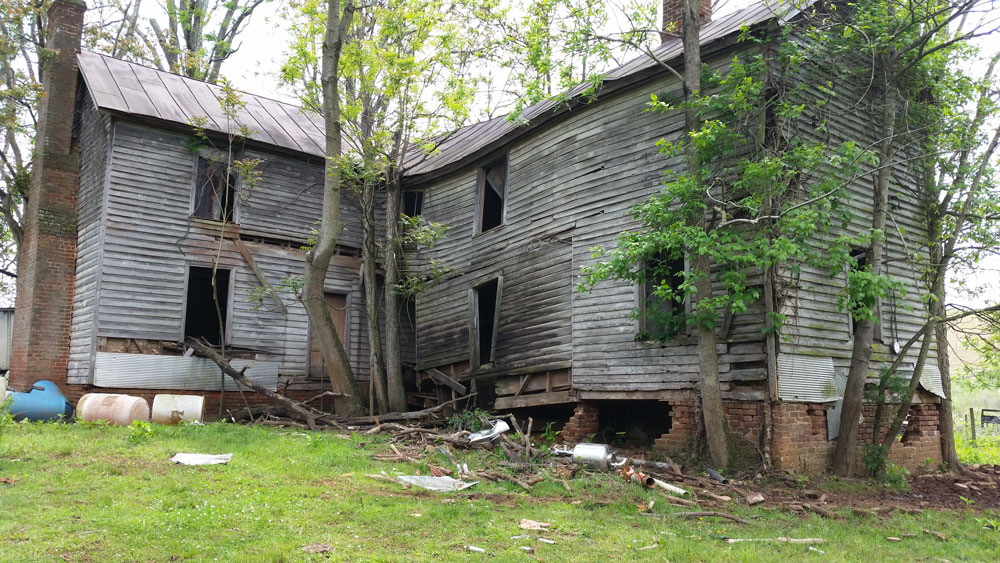
The back of the cabin is also falling in. The porch and its roof collapsed and fell over a decade ago.


These notches show where the back porch roof once was attached.


The spring, where water was fetched a couple of times a day, was down this hill and and across a creek. The Smiths' cow also lived down here, but was fenced out of the spring and spring box. A branch ran from the spring and eventually connected to the creek.


This hillside between cabin and spring was once the site of the Smiths' garden.


The creek—and then the spring and its branch—are the other side of the trees at the bottom.


Beside the farm road that leads to the cabin is an ancient walnut tree. It was huge  when I was a kid 75 years ago.


Every year, it looks like it's dying . . .


. . .  but by late spring, after the surrounding trees have leafed out, it starts to sprout leaves. Every year—so far—it still bears walnuts.


At least a few things remain.

~

Labels: , , , , ,

Friday, September 29, 2017

Clement-Witcher Feud

A few miles from me as the crow flies, three brothers who all died the same day in 1860 are buried in a single grave on the family plantation—"Mountain View" on Snow Creek Road in Penhook. How did this triple death happen? Turns out a woman was involved—and she was a Smith, though I don't know if she and I descend from a common Smith ancestor.


Victoria Smith, the daughter of Albert G. Smith, was beautiful and had many beaux in the Franklin-Pittsylvania County area. She came from a good family; her grandfather was Vincent Oliver Witcher, the great-grandson son of Revolutionary War Colonel William Witcher and the son of Capt. Vincent Witcher who served in the Virginia Senate and House of Delegates prior to the Civil War.

Victoria married James Clement, the son of Dr. George W. Clement, and here's another  Smith connection: James's mother was Stella Smith, daughter of John Smith of Lewis Island (the road I live on used to be called Lewis Island Road). This John Smith was the son of John Smith of "The "Pocket," a large plantation in the bend of the Smith River.

Unfortunately, the marriage was not happy, and Victoria became so afraid of her husband that she sought divorce. The divorce proceedings were where thing turned ugly.

The story has been told in print several times. One of the oldest is from An Old Virginia Court, by Marshall Wingfield, D.D., who wrote several histories of Franklin County.

From "An Old Virginia Court" by Marshall Wingfield, D.D., Memphis, Tennessee, The West Tennessee Historical Society.

The killing of three Clement brothes---James,William and Ralph by Capt. Vincent Witcher, John A Smith, Vincent Oliver Smith, Samuel Swanson and Addison Witcher. Addison Witcher was the son of Vincent Witcher. John and Vincent Oliver Smith were his grandsons. Samuel Swanson was his son-in-law.

James Clement married Victoria Smith on March13, 1858. He was one of ten children of Dr George W Clement, born1786; married 1811; died 1867. Dr Clement was educated at Hampton-SydneyCollege and the Medical Department of the University of Pennsylvania. His mother, Stella Smith, was the daughter of Major John Smith of LewisIsland. Their Franklin County home was called "Mountain View".

Victoria Smith was the daughter of Albert G Smith and the granddaughter of Capt. Vincent Witcher. She was born in 1837. The Smith family regarded the Clement family as of inferior social station. Dr Clement was very proud of the beauty and wit of his daughter-in-law, Victoria. Two of her old sweethearts continued their attentions after her marriage(of innocent nature). They were William P Gilbert and Samuel D Berger. Her husband, James Clement, accused her of unfaithfulness and humiliated her. Fearing physical violence, Victoria Smith Clement,fled from her husband on the night of August 24, 1859, and found refuge in the home of Sherwood Y Shelton, who lived a mile distant. She left behind her six month old baby, Leila Maud, born March 1, 1859, so great was her terror., In three weeks, the taking of depositions was begun at Dickenson's Store, to be read as evidence in the suit then pending between John A Smith, next friend of Victoria Smith Clement, plantiff, against James R Clement, defendant. The taking of depositions continued until February 25, 1860, when the Clement brothers were killed. Capt.Vincent Witcher objected to having Elizabeth W Bennett make part of herstatement on Saturday "and then being left in the hands of the oppositeparty to be picked until Monday." He made the statement that shewas under control of the Clements.Ralph Clement said "that whoever saidthat was a damned lie." Capt. Vincent Witcher drew a "five shooter" and started firing at Ralph Clement. Addison Witcher conducted the examination for the plantif. (Robert Mitchell, Justice of the Peace,appeared to have forgotten everything that transpired).

The bodies of the Clements were riddled with bullets and gashed with knives. William Clement was disembowled; James Clement's throat was slit from ear to ear. Ralph Clement lived three hours and made a dying declaration: I never attempted to draw an arm. Addison Witcher caught and held me and told them to come shoot me. A damned rasccal Robert W Powell stated in his deposition that Addison Witcher held RalphClements while Vincent Oliver Smith shot him. George Finney statedin his deposition that John Anthony Smith shot and stabbed James Clement. Both James and William Clement were reclining on a bed in the Counting Room when the firing began. Some thought the early firing came from the bed. The Pistols of both James and William Clement had been fired until empty, but Ralph had not drawn a gun. The three bodies were carried from Washington Dickinson's Counting room, in a farm wagon, and buried in a simple grave near the shaded driveway to the old brick house,their boyhood home.

The defendants claimed self-defense and charges were dismissed, March 23, 1860. In June 1860, the depositions were published in book form by Dr. G W Clement, Sr.

Dr. George W Clement's mother, Stella, was the daughter of John Smith of Lewis Island, son of Mr John Smith of "The Pocket". 1700
(Clement: History of Pittsylvania County)

You can read more online about the Clement-Witcher feud at these sites: "The Clement-Witcher Case," "Allegations of Infidelity at Heart of Massacre," "The Witcher-Clement Case," and a page on Rootsweb.

Some print books about the case are also available. The late Franklin County historian A.D. Ramsey wrote about the case many decades ago. I bought his booklet at The Frankin County Historical Society several years ago. Local historian Beverly Merritt's book, The Untold Story of the Clement-Witcher Feud, is a transcript of the trial.


Victoria was in her early twenties when the picture at the top of this page was taken. Here is a picture of me when I was twenty. 


If you squint a bit, I look like her just a little around the eyes and nose Or maybe it's my imagination. But I would like to know if she and I might might somehow be kin on the Smith side.
~

Labels: ,

Friday, April 07, 2017

Lilacs and Connections


My lilac bush is blooming. Brought from a slip off the bush on Smith Farm, it is an old-timey lilac with a wonderful fragrance. The original lilac bush was planted by the old kitchen house near the cabin, but what's left of the kitchen has been just a pile of rocks for nearly a century.


My Aunt Belva—who died in 2003—once told me that when she was a child, she and her younger sister Virgie—who is 99—were playing in the old kitchen when it fell in. I'd always thought of the kitchen—and lilac—as my Granny Sallie's, but now I realize the kitchen was Gillie Ann Bernard's. It's likely Gillie Ann planted the lilac. Gillie Ann died in 1897 and was the first resident of the cemetery up on the hill. 


Her husband William had a window cut in the cabin wall so he could sit by the fireplace and see her grave. This window also provided a view of the lilac bush. William joined Gillie Ann on the hill in 1907. (I blogged about that cemetery in my "Vines and Stones" post in 2011 and again in 2014 in "Special Delivery.")


Until recently, I didn't know I had a connection to Gillie Ann, but it turns out that she's my first cousin. three times removed.  Here's how: Gillie Ann Bernard is the daughter of Gwin—or Gwynn—Dudley (1810-1846) and Nancy Eliza Smith (1815-1890). Nancy Eliza is the daughter of my 3rd-great-grandfather, John Wood Smith (?-1842), who lived just down the road apiece from where Smith Farm is. John Wood Smith was married to Lucy English (1791-abt. 1850), daughter of George Lewis English and Ann (Nancy) Smith, the daughter of Col. John Smith and his wife Frances. It is likely that Col. John Smith (1735-1820) is somehow kin to John Wood Smith, so Gillie and I might be kin in another way, too. All of these folks lived within a few miles of each other in Union Hall. 


Anyhow, Gillie Ann Dudley Bernard and my great-grandfather, Henry Silas Smith (1854-1923) are both grandchildren of John Wood Smith—and that's my connection. 


In long-ago Aprils, my distant cousin must have enjoyed the smell of lilac blossoms outside her kitchen door. Over a century later, I'm enjoying them too.
~

Labels: , , , , ,

Sunday, February 26, 2017

Minnie McBride Murder

Thanks to Brenda Overholt, my distant cousin a few different ways, for some additional information about Minnie.


When I posted "A Rose for Minnie" back in 2010, I didn't know many of the details about Minnie McBride's murder. From what my daddy told me as a kid—"Old woman kilt her with an ax"—I knew she was young and had been murdered. 

Minnie's stone in Bethel Church graveyard.
Later I found out that her murderer was Lucy Mitchell, a 40-something woman who lived and  worked in the household where Minnie was killed. But recently, I've found out much more about Minnie and her sad life. A search on Ancestry.com revealed that Minnie, born in 1891, was the daughter of William Davis McBride (1871-1929) and Jennie Bell Brooks (1872-1900). She had two younger brothers and a sister—Chapman (1893-1908), William Lester (1895-1985), and Grace Bell (1898-1984).

From Brenda Overholt, I learned that after Minnie's mother's death (around 1900), her father placed his two boys, Chapman and Lester, with his half-brother, John Henry Brown. John Henry and his wife Lauretta Wright had several children, but they took in the boys nonetheless. He placed Minnie and Gracie with his half-sister  Sallie Fannie Brown Crum and her husband, Joseph Robert Wesley Crum. Then William Davis McBride took off for West Virginia, where he had some relatives, and started a new life. He likely never saw Minnie again.

I recently learned I have a connection to Minnie: My grandmother, Sallie Lee Brown Smith (who was married to Joseph Robert Smith), and Minnie's half-aunt, Sallie Fannie Brown Crum, were second cousins. Both were the great-granddaughters of Daniel Brown and Martha Joice Snider. 

The Crums, who had no children of their own, were well off financially. Mr. Crum was a county official and was also a farmer. The Crum's house was somewhere behind the Old Salem School. According to the 1900 Union Hall census, Minnie was 9 and a member of the Crum household. Did Minnie attend Salem School? It would likely have been just a short walk for her.

Old Salem School in 2015.
The woods behind the school were likely where the Crum farm was.
My grandparents' farm was about a mile as the crow flies from Salem School. Both my grandparents and the Crums attended Bethel Church.

Minnie's little brother, Chapman McBride, died in March 1908. He'd been ill, possibly with measles earlier in the year, but was made to work out in the cold. But Minnie was getting her life together. A pretty girl, she was engaged to marry her sweetheart Walter Irving Johnson. No doubt she dreamed of living happily ever after.

A newspaper article after Lucy was convicted gives a few details about Minnie's murder.


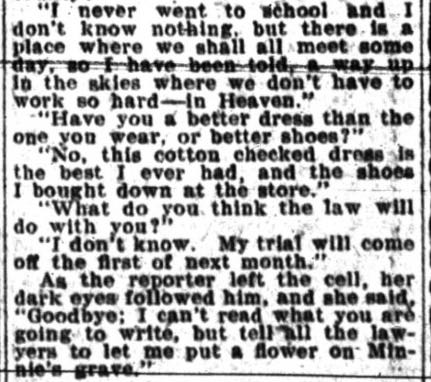
A month earlier, Lucy Mitchell had been interviewed by an unnamed reporter while she awaited trial. The clippings are a little hard to read, so you might have to click to enlarge them:


So Lucy Mitchell had a sad life too. The daughter of Iyanation Franklin Mitchell of Union Hall, Lucy had worked hard all her life and had never known love. And she was unattractive. One story says she had a hare-lip and big feet. At any rate, Lucy was likely envious of the attractive Minnie who was going to get married to Walter Irving Johnson the next day.

Here's the story about "one of the most horrible murders" in Franklin county that was attached to the previous interview, with a mention that Lucy had a grudge against Minnie's fiancé:


So—Lucy, who had worked as the Crums' servant for seven years, struck Minnie with a piece of wood  in the kitchen, a separate building from the main house. Minnie made it outside, but Lucy finished her off with the ax. Lucy had waited for two weeks and finally had an opportunity when Mrs. Crum and Grace were at Bethel Church and Mr. Crum was in Rocky Mount.

In a 10-page collection of memories written by Esterlene Smith Brooks Kesler, a close friend of Grace McBride Perdue, Mrs. Kesler wrote that Grace told her that Lucy had been sleeping with an ax for a couple weeks because she'd said she was afraid someone would come in the night. But Grace suspected that Lucy wanted to kill her as well as Minnie.

"Grace told that Minnie was first struck with a pine knot, and a trail of blood led from the kitchen table to the yard" where Lucy finished her off with the ax. "Investigators found the pine knot, but not the ax. In 1998, an ax was found in a sack when the kitchen was torn down. The blade was rusty and the handle was only about 18" long." Also in the sack was Minnie's hairclip with several teeth broken out. While the ax and clip were given to Grace's son, no one knows where they are today.

It didn't take long for the news to spread throughout the area, and a crowd began to form with the purpose of hanging Lucy.  Four or five men (including Brenda Overholt's great grandfather Isaiah "Zar" Perdue) came to walk Lucy to the train in Union Hall to take her to the poorhouse. "The men whipped Lucy's legs to make her trot and move fast." I can't help but wonder if my grandfather was one of the men who came to the Crum house. I guess I'll never know.

Soon, Lucy was taken to the jail in Roanoke for her own safety. Perhaps "the poorhouse" she might have been taken to was the Joseph Rives home in Redwood that served as the poorhouse in the 1800s.

Front of the Poorhouse.
Pictures from Brenda Overholt
Back of Poorhouse
Anyhow, after being kept in the Roanoke jail for a few months, she was brought back to Rocky Mount for trial where he was found guilty, sentenced to eighteen years, and sent to prison in Richmond. There she died of tuberculosis in 1913. During her incarceration, she worked in the prison shoeshop as a "paster." It was probably easier work than what she'd been used to.

There are no happy endings to Minnie's and Lucy's story. 

But maybe there's a happy ending for one of Minnie's nephews. Minnie's brother Lester stayed with the Browns for years but was in Richmond in 1917 where he registered for the WWI draft. He was a clerk in Richmond in 1920 but at some point reconnected with his father and moved to West Virginia, where he married in 1923 and had several children. One of Lester's sons is John Andrew McBride, who had a long successful career as a military pilot and astronaut.
~

Labels: , , , , ,