Peevish Pen

Ruminations on reading, writing, genealogy and family history, rural living, retirement, aging—and sometimes cats.

© 2006-2025 All rights reserved

My Photo
Name:
Location: Rural Virginia, Virginia, United States

I'm an elderly retired teacher who writes. Among my books are Ferradiddledumday (Appalachian version of the Rumpelstiltskin story), Stuck (middle grade paranormal novel), Patches on the Same Quilt (novel set in Franklin County, VA), Them That Go (an Appalachian novel), Miracle of the Concrete Jesus & Other Stories, and several Kindle ebooks.

Friday, August 05, 2022

Why Genealogy?

 I got into genealogy late in life. I dabbled a bit in the pre-Internet days, but didn't find much at the local library—only a few names and dates. Once I had Internet access, though, I got lucky. But it still took me years to make the connection that genealogy is history.

Long ago, the 7th grade Virginia history and the 11th grade American history I studied didn't mean much to me. All the important events happened to people long before I was born and thus had no connection to me. Or so I thought.

I wish I had known on my 7th grade Virginia history trip to Richmond, Williamsburg, Yorktown, and Jamestown  that several ancestors had even been at Jamestown in the early 1600s, that one of my ancestors had laid out the town of Yorktown, that other ancestors had lived in Richmond—including the family scoundrel who had erected a lavish monument in Richmond's Hollywood Cemetery, and that many of my ancestors had moved westward across Virginia following a similar route that the Greyhound bus used to bring us home. 

It was only when I started working on my family genealogy that I became really interested in history—my history!—and started reading about events that affected my ancestors. I decided that—before I shuffled off the mortal coil—I wanted to know who I was,  who came before me, where these people came from, and what historical events affected them.

On my maternal side, I knew a few names of great-great grandparents and a cousin had given me a list of Nace descendants. I even had a picture of my great-great grandfather, John Christian Nace, who lived from 1828 to 1928 and had served in the Civil War. From some internet research, I learned that when he was a child, he shook hands with President Andrew Jackson.


John Christian Nace

Then, thanks to info gleaned at reunions, I learned a bit about the Noffsinger/Noftsinger line and that I descended from Peter Naftzger. 

On my paternal side, I had a picture of another great-great-grandfather,  Elder John Reid Martin. I'd seen his grave at Bethel Church when I was a child—but that was as far back as I could go. A few decades ago, however, I learned that his grandfather—my 4th great grandfather—was Brigadier General Joseph Martin. 

John Reid Martin

During the late 1990s, I'd started doing internet research and found occasional bits of info. By 2010, I'd found enough about my Nace ancestors to start a blog, The Naces of Lithia. But I didn't know much about other family lines. That's when I started searching for other names I'd learned, so I was able to find bits of information about several more ancestors. But not enough.

In 2015, I subscribed to Ancestry.com and started tracing my genealogy in earnest. Bit by bit, I found hints that led to discoveries about more of my ancestors. Sometimes I found false information, but I soon learned to be skeptical of where information came from and to check sources. Before long, though, I had a family tree filled out on Ancestry.com and four notebooks packed with information about my ancestors.


My Nace notebook and Ruble notebook.

I know now that many of my ancestors fought in wars I'd read about when I was a kid—the French and Indian War, the Revolutionary War, the War of 1812, and the Civil War. I know most of my ancestors sailed to America before 1750, and many were involved in a lot of Colonial American history. Among my Jamestown ancestors, at least two—Willliam Hancock on my paternal side and Christopher Woodward on my maternal side—died in the 1622 Indian Massacre. 

I had ancestors on both sides in Bacon's Rebellion (1676), an event that I can't remember hearing about when I was in school. I even learned that my 8th great-grandmother was taken hostage by Nathaniel Bacon and used as a human shield.

I've been to Yorktown many times—the first time on that 7th grade trip—but I never knew until a few years ago that my 10th great-grandfather, Major Lawrence Smith (1629-1700), who was involved in Bacon's Rebellion (on Gov. Berkeley's side), surveyed and laid out the streets of Yorktown. 


—Daily Press, Newport News, VA, 19 Oct 1958

From Encyclopedia of Virginia Biography, Vol. 1:


I'd never thought about any American ancestors outside of Virginia, but as I researched I learned I also had New England connections. My 9th great grandfather, Robert Coles, came from England to Massachusetts in 1630 as one of the Puritans in Winthrop's fleet. I was surprised and delighted to discover so much about him online—including that he was once sentenced to wear a letter "D" for drunkard. A few sites I found about him: About Robert Coles, "Scarlet Letters of Punishment," and  "Robert Coles—Skeletons in the Colonial Closet."

Besides Coles, I also had Carpenters and Wrights in New England. During the mid-1700s, they came down the Great Wagon Road to Virginia.

Some of my ancestors came from the Palatinate to Philadelphia in the 1700s—among them were Matthias Nehs and his family aboard the Brittania in 1731,  Heinrich Surber and family aboard the Mercury in 1735, and Peter Nafsker and his two brothers aboard the Phoenix in 1749. I can't remember any mention of the Palatinate when I was in school.

I wish I had known about all these ancestors and the times in which they lived when I was a child. If you have children, I recommend you get them involved in learning about their ancestors while they're young. If you don't know who your ancestors are, you can work along with the kids to solve the mysteries. 

For some tips for getting your children started on your family's genealogy, check out these two sites:  https://www.americanancestors.org/education/learning-resources/read/getting-started and "Finding your Roots for Kids."

~

Labels: ,

Sunday, October 01, 2017

Margie Odell Caldwell Ruble

Correcting Genealogical Errors

From doing online genealogical research on my family, I've learned that there are lots of errors and stumbling blocks. One of them involves the name of my great-grandmother on my Ruble side.  I've blogged about her before— on "The Ruble Connection" on my Naces of  Lithia blog and on this blog back in 2014: "Tangled Ruble Roots." Thus, some of the info in this post might be a bit redundant, but I'd like to get the word out on what her real name was.

 My great-grandmother's full name is Margie Odell Caldwell Ruble, but a lot of sites—as well as several trees on Ancestry.com—mistake her for her older sister Maggie. Or they think her name is Margaret or Marga or Margie Logan. Or they get her birthdate confused with Maggie's. (Margie and Maggie's parents were Alexander Gibson Caldwell and Marcellus Surber.)

This picture of Margie and her husband George William Ruble was taken before 1935, because that's the year he died.

I know the picture was taken at their son Howard Ruble's house on Watts Avenue in Roanoke because the background still looked like that in the 1950s when I was a kid. I also remember hearing my grandmother Blanche Nace Ruble refer to her mother-in-law as Margie. 

I think a lot of problems with her correct name might have started when someone got it wrong and a lot of others copied the error. When doing genealogy, it's best to work with primary sources rather than heresay.

My Aunt Leona—Margie's daughter—wrote this note for me when I was a child so I would know who my family was. Aunt Leona was off a digit in her grandfather's birthdate, but the names of his children look correct. Also, I'm not sure about Caroline Surber—I think she was an aunt rather than a grandmother—but, according to census records, she lived near Marcellus's father Henry Surber.


Notice that Maggie L. Caldwell—Margie's older sister—was born on May 9, 1859, before her father—Alexander Gibson Caldwell—went to war. Margie O. Caldwell and her twin sister Montra were born on February 25, 1866, after the war was over. (Note: To add to the confusion, on her Find-a-Grave site, Montra's name is spelled Mauntra and her birthdate is a year off.)

The Ruble family bible is another primary source. According to this page from it, George William Ruble was born on June 17, 1861, and his wife Margie Odell Ruble was born February 25, 1866. A note at the bottom says they were married October 14, 1884.


Another piece of evidence is this 1920 census where Margie O. (age 53) is the wife of Geo William Ruble (age 58). Their sons Kenneth, Bertranse, Stewart, and Eugene are still at home:


Their tombstone is hard to read, but you can see the name is Margie. It's not Margaret.


Margie's death certificate clearly identifies her as Margie Odell Ruble.


Her husband's death certificate identifies her as Margie Caldwell Ruble.


So, from looking at some good primary sources, we know that her name was Margie—not Maggie, not Margaret.

Perhaps this blog-post will help folks who are researching the wife of George William Ruble learn that her real name was Margie Odell Caldwell Ruble.

UPDATE: Thanks to ancestry.com, I was able to find out what happened to Margaret/Maggie Logan Caldwell. On June 21, 1888, she married E.D. Broughman in Alleghany, Virginia (FHL Film number 30523, Reference ID  p37L28). She was a widow when she died on March 31, 1926, at Little Sisters of the Poor, 16 N. Harvie Street in Richmond. Her death certificate notes that she was formerly of Clifton Forge, Virginia, but had been in Richmond four years.


Her parents are listed as "Alex Calwell" and "Marcella Serbert," which is close to Alex Caldwell and Marcellus Surber, but both are listed as being born in "England" instead of Virginia. Was someone trying to hide something, or did they just not know? And why was she in Richmond? If she were living with a child, wouldn't that child have given information for the death certificate instead of Sister Catherine? Perhaps she had no children, and thus ended up in a home for the "elderly poor."

Little Sisters of the Poor
(now Warsaw Condominiums)
Some things still remain a mystery.
~

Labels: , , , ,

Thursday, September 07, 2017

Childhood Food

This meme, which has been making its way around FaceBook recently, made me recall food from my childhood from the late 40s through the 50s in Roanoke, Virginia:


How many of these do I remember?

Pasta: I don't recall the word "pasta" being used when I was a kid. The only kinds I knew were macaroni and the little letters of the alphabet in soup. Never had spaghetti or lasagna until I was in college, even though Chef Boyardee had been advertising on TV in the 50s.

Curry: Never ate anything curied until I was an adult. Don't particularly care for it now.

Take-away: Yeah, it was math! We said "take away" instead of "minus" in elementary school. Is "take-away" the same as "take-out"? "Take-out" food didn't exist when I was a kid—at least I never heard of it then. But then, we didn't eat out, except for an occasional hot dog at a dimestore lunch counter downtown. I suppose my first experience with "take-out" was getting a Kenny Burger at the stand on Williamson Road as I walked home from William Fleming High School when I was in the 8th grade, or maybe it was the 9th grade. Anyhow, the price was right.


Pizza: Another food I never ate until college. Some folks called it "pizza pie." I can remember getting my mother to buy a frozen pizza from Mick-or-Mack in 66 or 67 when I was home on break. I don't remember what brand it was, but I do remember that it wasn't too many years until pizza ads appeared on TV.  I remember eating pizza at Pizza Hut on Hershberger Road in the early 70s when I was back in Roanoke. Soon there were other pizza places or restaurants that served pizza.

Bananas and oranges: We had these year round. Fresh oranges were the source for orange juice, which Mama squeezed herself using this juicer. (I mentioned it on my post "Old Things" a few years ago.)


We also sometimes sucked on oranges that had a hole cut in the top. After we'd sucked out the juice, we peeled apart the skin and ate the remaining pulp. A little messy, but good. I saw fresh pineapple in the grocery store, but usually we had the rings that came in a can. Mama made good pineapple upside down cake with those rings.

Chips: Yep, they were plain. The best ones I remember from my childhood were fresh off the conveyor belt at the Lay's Potato Chip Company on Williamson Road. I'd gone there with my daddy when I was about five. The man grabbed a paper bag, scooped up a bagful of still hot chips, and handed them to me. I ate them on the way home. When I was in junior high and high school, a handful of chips wrapped in wax paper was in my lunchbag every day.

Oil and fat: Mama fried food in Crisco, which was supposed to be an improvement on lard. I don't remember oil until "vegetable oil" came along later. I never used olive oil until 10 or 15 years ago. Now it's a staple in my kitchen.

Other stuff: Mama made tea from Lipton tea-bags, we never had sugar cubes (way too posh for us!), and I'd never heard of yogurt until I was an adult. I'd heard of  people eating "shish-kebobs" on TV shows, but we never had any.

I never heard of broccoli, brussel sprouts, or cauliflower until I was in college—where I also discovered blueberry pie and tuna casserole. I ate my first zucchini in 1971 and my first eggplant a few years later. I don't think I ate a bagel until the 80s. Food we ate was limited to what grew in our garden or what was easily obtainable. Mama and Grandma always had gardens and canned their surplus. Here's a 1932 picture of Grandma in her garden on Watts Avenue in 1932:


Our main vegetables in the 40s and 50s were potatoes, corn, green beans, tomatoes, peas, lima beans, cabbage, and yellow squash. Potatoes were rarely baked, most often sliced into round slices and fried. Squash was sliced and fried, too. Sometimes we had fried okra. Most lunches and suppers year round featured at least two—and sometimes all three—of the following veggies: potatoes, corn, and green beans.

Besides canning tomatoes, corn, and green beans, Mama canned chow-chow, pickles, sauerkraut, and pickled beets, but I didn't like those as a kid. Consequently, I didn't have much variety in my meals.

For meat, we had chicken (always dipped in flour and fried, never baked), beef-steak (which was pounded with a hammer-like tool to tenderize it) and then dipped in flour before it was fried, salmon cakes (always fried), hot dogs (always boiled) with a piece of bread wrapped around it for a bun, ham (slices were fried; a whole ham was baked), and—at Thanksgiving or Christmas—a turkey, which was baked. The turkey was never stuffed; dressing (never called "stuffing") made from white bread, onions, and celery was served as a separate dish. Once in a while, we might have fried fish. Sometimes we ate canned Spam (fried, of course) or bologna (pronounced "baloney") sandwiches. We never ate lamb or duck or lobster or shrimp. We might have oysters—dipped in cornmeal and fried—once or twice during the winter.

Most food was made from scratch, the exception being canned soup which was just re-heated.

Bread was white sandwich bread—usually Merita or Rainbow. No one ate brown bread or bread with "whole grain" in it. Sometimes there were biscuits at breakfast or rolls at dinner—especially after "brown and serve" rolls becme available. Once in a while, there'd be homemade "light rolls" which were crusty on top and bottom but soft inside. They were wonderful. I blogged about Grandma's light bread recipe a decade ago on this blog post.

We didn't eat a big variety of foods in the 50s, but we didn't go hungry.
~

Labels: ,

Friday, April 07, 2017

Lilacs and Connections


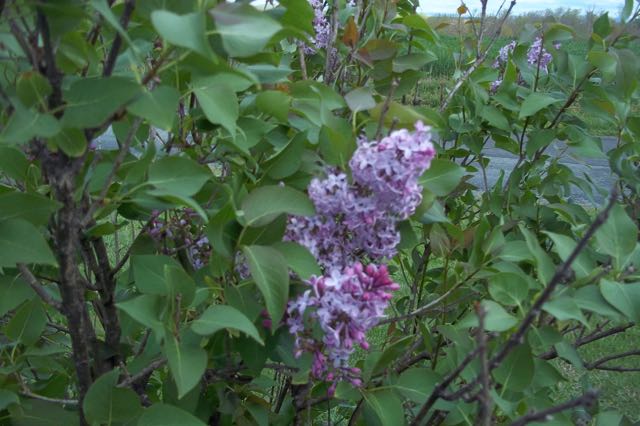
My lilac bush is blooming. Brought from a slip off the bush on Smith Farm, it is an old-timey lilac with a wonderful fragrance. The original lilac bush was planted by the old kitchen house near the cabin, but what's left of the kitchen has been just a pile of rocks for nearly a century.


My Aunt Belva—who died in 2003—once told me that when she was a child, she and her younger sister Virgie—who is 99—were playing in the old kitchen when it fell in. I'd always thought of the kitchen—and lilac—as my Granny Sallie's, but now I realize the kitchen was Gillie Ann Bernard's. It's likely Gillie Ann planted the lilac. Gillie Ann died in 1897 and was the first resident of the cemetery up on the hill. 


Her husband William had a window cut in the cabin wall so he could sit by the fireplace and see her grave. This window also provided a view of the lilac bush. William joined Gillie Ann on the hill in 1907. (I blogged about that cemetery in my "Vines and Stones" post in 2011 and again in 2014 in "Special Delivery.")


Until recently, I didn't know I had a connection to Gillie Ann, but it turns out that she's my first cousin. three times removed.  Here's how: Gillie Ann Bernard is the daughter of Gwin—or Gwynn—Dudley (1810-1846) and Nancy Eliza Smith (1815-1890). Nancy Eliza is the daughter of my 3rd-great-grandfather, John Wood Smith (?-1842), who lived just down the road apiece from where Smith Farm is. John Wood Smith was married to Lucy English (1791-abt. 1850), daughter of George Lewis English and Ann (Nancy) Smith, the daughter of Col. John Smith and his wife Frances. It is likely that Col. John Smith (1735-1820) is somehow kin to John Wood Smith, so Gillie and I might be kin in another way, too. All of these folks lived within a few miles of each other in Union Hall. 


Anyhow, Gillie Ann Dudley Bernard and my great-grandfather, Henry Silas Smith (1854-1923) are both grandchildren of John Wood Smith—and that's my connection. 


In long-ago Aprils, my distant cousin must have enjoyed the smell of lilac blossoms outside her kitchen door. Over a century later, I'm enjoying them too.
~

Labels: , , , , ,

Friday, March 06, 2015

Genealogy Mysteries in Maryland

I've been poking around my genealogy for several months now. Since I recently learned—while checking on my Webb ancestry—that I descend from Moses Greer, Sr., one of the  founders  of Franklin County, I've been looking up the Greer line. The Internet has, of course, provided a wealth of resources, and it wasn't long before I learned the Franklin County Greers descended from the Gunpowder River, Maryland, Greers.

Knowing where they came from made looking them up easier, and I found numerous Internet posts revealing that those Greers came from a long line of Lords of Lag in Scotland.


as shown in 
The Historical Families and the Border Wars, 
by C. L. Johnstone, 1878.

I learned that before they were Greers/Grears,/Griers, the ancestors were Griersons, and before that MacGregors. A bit of poking around the Internet revealed a thousand years of my history—OR NOT.

There's a problem with the founder of the American line—James Greer. Or Grear. Or Grier. Born in 1627, James came to Maryland as an indentured servant in 1674-75 aboard the Batchelor of Bristoll, captained by Samuell Gibbons, who made a tidy profit from hauling ninety or so servants to America. The "list of servants transported by Samuell Gibbons of Bristoll in the Ship Batchelor of Bristoll 1674" is here, as is other information about these servants.


The ship's captain not only made a tidy profit from hauling 90 servants to Maryland, some others also did:


Know all men by these presents that I Robert Ridgely of St. Mary's City for a valuable consideration to me paid by Thomas Selby of Somerset County do Assign, Sell and make over unto the said Thomas all my right, Title and Interest of, in and to Twenty five Rights to Land to me due by assignment from Samuell Gibbons of Bristoll, merchant, due the said Samuell for Transporting Robert Hutchins, Robert Mackahee, Agnes Sincler, John Grey, Thomas Mercer, Anthony Winslow, William Winslow, James Winslow, John Miller, James Grear, John Lynsey, John Keane, John Macknamerry, Jeffery Mackvey, Mathew Shaw, John Bradshaw, John Tarneck, Alexander Wallis, Daniell Henry, John Mackelman, Robert Orr, Hugh Maynard, James Feilding, Andrew Agnew, and Daniell Macknele into this province to Inhabit. To have and to hold the Said five and Twenty Rights to Land to him the Said Thomas Selby, his heirs and Assigns forever, Witness my hand and Seale this Sixth of November 1674
Witnesses: John Blomfeild    Robert Ridgely {Seale} Robert Ellis


Why would a member of a well-to-do Scottish family sell himself into servitude? Others apparently wondered the same thing, and I found a few sources that indicated there were two James Griers. Did they get mixed up somehow? 

A trip to the Franklin County Historical Society to look at the big Greer chart revealed this: "James Grier, 2nd son, born 1627, and emigrated with Samuel Gibbons 2 Nov. 1675. Died 1688 in Maryland." (It's the info by the star below.)


Emigrated? What a tactful way to phrase it. Too much evidence exists, however, that the Maryland  James was a servant and not a nobleman. Meanwhile, back in Scotland, the other James Grier had apprenticed himself to an apothecary/surgeon, a respectful enough career for one who isn't the first son (and thus the inheritor) in a well-to-do family.

I'm not the only one who is suspicious suspicious. From http://www.myheritage.com/dna-surname-project/Greer:


A tradition seems to have developed among a number of these families that they are descended from a James Grier of the family of Capenoch, son of Sir James Grier and Mary Browne, probably born in the early 1630s. He is mentioned on the "Carrickfergus" tree as "James Grier M.D. of Edinburgh, died unmar." Whilst this tree is known to have many errors, this would appear to not be one of them. Recent research by Richard Miller has uncovered that James Grierson of Capenoch was buried on 23 January 1662 in Greyfriars Church, Edinburgh. Contact with the Scottish Genealogical Society in Edinburgh confirmed that the burial was of James Grier(son) of Capenoch who was an MD (Apothecary) and died unmarried in Edinburgh. We will have to look elsewhere for the immigrant James Grier or Grear. There are, however, persistent rumours that members of the Capenoch family emigrated to Ireland at various times. It may be from those migrations that the American Greers spring. 

There are other online references raising suspicions about the Maryland James Grier, but you get the gist. So where did my Greer ancestor originate? Odds are good, since the ship sailed from Bristol, England, and made some stops along the Irish coast, that he could have come from Ireland. But I don't know for sure.  

Update: Since some of the links above go to different sites  than they did when I originally posted, here is an update about the passengers on the Batchelor of Bristol: http://files.usgwarchives.net/md/somerset/history/area/batchlo3.txt

Another mystery involves Samuel and Grisselle Smith, who may or may not have come to Halifax County from Maryland in the 1700s. Back then Halifax encompassed part of what is now Franklin County. To complicate matters, Mrs. Samuel Smith's name is spelled lots of ways—Griselda, Grissel, Grizzel, Grezzel, Grisley, etc.


Anyhow, on 26 September 1732 in Prince George MD, one Samuel Smith (born 1708 in Middlesex, VA, died 1776 in Bedford, VA) married Grissel Locker (b. 28 Feb 1715 in St. John's Parish, Prince George MD, and died 1786 in Bedford, VA). She was supposedly the daughter of Thomas and Elinor Evans Locker, and Samuel was the son of Nicholas (b. 1680; died 1757) and Ann Smith of Essex, VA.

Another Smith born in VA also married a woman with a similar first name: "The 1748 King and Queen Co., VA will of Thomas Coleman shows that his daughter Grizzel was married to a Mr. Smith." This Samuel Smith was involved in land transactions in the Franklin County area as early as 1759.

Anyhow, I've come across sites where all of Sam and Grisley's 13 children were born in Maryland from 1735 through 1759, another that says daughter Anne was born in Virginia in 1740, another that says Samuel and Grisley were both born in 1738 in Halifax (with their son John born in Halifax in 1750 and died in Franklin County in 1800).


My guess is that the two Samuel Smith families are pretty well tangled together and have confused many researchers. Anyhow, as I try to untangle these  family lines, I'm pretty confused myself.

~


Labels: ,

Tuesday, January 20, 2015

Search and Research

Warning: More genealogy that is probably only interesting to me.

Lately I've become interested in family genealogy—especially on my Smith side. I've long wondered from whom I descend. For the past few months, I've been doing a lot of searching and have already posted some things I've learned about my Martin great-grandmother ("Martin Mystery" and "Martin Mystery II") and my recent discovery of my Hancock ancestors who lived right in the neighborhood ("Lewis and Celia Hancock").


But, while scouring family trees on Ancestry.com, I've run into some glitches. The Hancock side has provided a lot of mysteries. It was easy to find that Lewis Hancock descended from John D. Hancock who descended from Benjamin Hancock, but further back gets a little fuzzy.

Apparently I—and a gazillion other Virginians—descend from William Hancock, born 1580 in Devonshire, England. Unfortunately, he had the misfortune to be massacred at Berkley Hundred in Jamestown on March 22, 1622. However, back in England he left three sons—Augustine (b. abt. 1605), Simon (b. abt.1612), and William (b. abt. 1615)— who eventually came to Virginia when they came of age. So now we have a William II (who died in 1693 in Surry County, VA, where a bunch of Hancocks ended up).

But—some websites say that this son William died at Bacon's Rebellion, which was in 1676. A William Hancock is on the list of participants, but it doesn't say what happened to him. On some sites, another William Hancock, born in 1640, is identified as being the one in Bacon's Rebellion. This site identifies him as the son of William II. But other sites say that William III was the son of Simon. Confused yet? So am I.

At any rate, the Bacon's Rebellion William only had one son, John, who was born around 1670 and had eight children, though some sites give his birth as later—like this tree I grabbed off the Internet which has John being born three years after Bacon's Rebellion where his father supposedly died.


Do you see anything else confusing about that tree? The birth dates of Benjamin's parents, maybe? It's a bit had to believe that William was sixteen and Elizabeth was fourteen when their son was born. Since John Hancock (1670-1732) had sons named William and Benjamin, I'm thinking that the two brothers somehow got onto different lines in the above chart. But I could be wrong.

Since the Hancock family had to get to Franklin County, I keep looking for westward movement as I check family trees. Lewis came from Fluvanna/Albemarle, his father John D. was in Albemarle, so that movement makes sense.


I've also been wondering about the Haynes line that ties into my English line. This tree for Dinah Haynes on another line in my family is even stranger than the Hancock tree above. Do you see the problem?


If this tree is to be believed, Dinah Haynes' mother Mary Smith was also her father's mother. But wait—the dates are different for the two Mary Smiths even though they have the same parents. So, is it possible that Guy Smith and his wife (Miss Perrin/Grace Perrin) had two Mary Smiths, born 31 years apart?  And that Guy fathered the 1670 Mary when he was five years old!? (If so, he must have been quite a guy.) And—even stranger—"Miss Perrin" (born 1685) gave birth to Mary fifteen years before she herself was born??!! My mind boggles.

I'm pretty sure that Dinah's father was indeed Henry Haynes, because he mentions his daughter Dinah and her son Henry in his will (he died in Henry County the year before Franklin county was formed):

Item, I give to my daughter DINAH ENGLISH my Negro Boy named Barnaby during her life and after her decease to my Grandson HENRY ENGLISH forever and also my using Skillett to her forever.

Though Henry was born in King and Queen County, he moved westward and southward, acquiring and then selling land in Spotsylvania and acquiring a patent for 400 acres in Orange County in 1739. In 1753, he moved closer:

1753 Pittsylvania County, Virginia, Henry Haynes acquired 400 acres beginning at the mouth of Bull Run Creek, thence down Blackwater River. Also 400 acres in the fork of said Bull Run Creek. Also 1753 Henry Haynes acquired 300 acres beginning at Robert Walton's upper line on Bull Run, thence up both sides of said Run, also 400 acres beginning at Randolph's lower lines on Staunton River, then down to Smith's Mountain. 

Part of Pittsylvania County eventually became part of Franklin County. (Franklin County  was formed from parts of Henry and Bedford Counties in 1785, a year after Henry's death.) Some of his land is now under Smith Mountain Lake. Some of it was owned by my Smith ancestors in the late 1700s. And I now own land on the upper part of Bull Run Creek that once ran into the Blackwater River but now runs into Smith Mountain Lake.

So, I think Henry is my ancestor. But I wonder about ones before him—I'm not so sure the ones on the above tree are correct.

I also wonder whatever became of the "using skillet" he left Dinah. I wonder if one of her descendants is still using it.
~

Labels: , , ,

Wednesday, January 07, 2015

Martin Mystery II

In an attempt to find the identity of my great-great grandmother Elizabeth S. Webb—the mother of Mariah Martin—I joined Ancestry.com. (They were running a special on membership!) I discovered that what I suspected—that her first name did start with an S and that it was Sarah—was true.

Ancestry.com gave me access to a lot of family trees, some of which did erroneously have second wife Elizabeth Wade as the mother of the last six of John Reid Martin's six children (while listing her as dying in 1850, before these kids were born). But—many did indeed have Sarah Elizabeth Webb as their mother. And most of those provided a lengthy pedigree for her. (I quickly learned to check the trees that had documented sources.)

Here's one (of several) that shows her paternal ancestors . . .


. . . and one (of several) that shows her maternal ancestors, but this one leaves out one of her children:


Sarah Elizabeth, born January 12, 1822, was the oldest child of Theodorick F. Webb (1799-1880), a primitive Baptist minister (like Sarah Elizabeth's husband!) and successful farmer.  (Theodorick's name is sometimes spelled Theodrick or Theoderick in some trees.)   His first wife was Nancy Tate Greer Calloway (1810-1860), who descended from two early prominent families of Franklin County—the Greers and the Calloways. They were married on January 17, 1821. 

How Sarah Elizabeth got her name isn't much of a mystery. The practice in those days was to name a child—especially the eldest—after grandparents or other close relatives: she was named Sarah for her paternal grandmother Sarah Huff (and maternal great-grandmother Sarah Tate) and Elizabeth for her maternal grandmother Elizabeth Greer (and paternal great-grandmother Elizabeth Webb). Given the traditions of the times, how could she be named anything else but Sarah Elizabeth? (And she, of course, named her first-born daughter Nancy after her mother and great-grandmother.)

Theodorick and Nancy had a large family. Sarah Elizabeth's siblings were Emily 1821-24), Tazewell Armistead (1824-after 1880), Henry Callaway (1828-after 1890), Mary Catherine (1832-?) Theodrick F. (1835-1918), Bird Langhorn (1837-1918), Ursula 1840-?), Serena (1842-?), James Thomas (1844-after 1880), Ramsey (1848-after 1900), and Daniel (1850).  She no doubt helped her mother with child care until her sister Mary was older.

Apparently in September 1838, when she was sixteen, her family went on a wagon train to Monroe County, Missouri. They were listed the Jackson township in the 1840 and 1850 census, but—and here's the mysterious part—they were back in Franklin County for the 1850 census. Theodorick had two land patents in 1841 and 1851.

Patentee Name   Given Name   Issue   Land Offi Doc.   Accession/

WEBB            Burd S      11/10/1841Palmyra  21478  MO2380__.465
WEBB            Burd S      11/10/1841Palmyra  21479  MO2380__.466
WEBB            Robert J    3/10/1843 Palmyra  21751  MO2390__.298
WEBB            Robert J    3/10/1843 Palmyra  21752  MO2390__.299
WEBB            Robert J    3/10/1843 Palmyra  21783  MO2390__.330
WEBB            Robert      9/10/1844 Palmyra  22523  MO2410__.109
WEBB            Theoderick F11/10/1841Palmyra  21478  MO2380__.465
WEBB            Theodorick F12/1/1851 Palmyra  25861  MO2470__.392
WEBB            William B   8/2/1852  Palmyra  27032  MO2490__.498

Ah, here's how he could be on two census listings: the 1850 Franklin County census took many months. Theoderick's family weren't counted until late December 1850. Notice that Sarah Elizabeth isn't among the group because she would had married John Reid Martin on April 1, 1850. (But another mystery—how did she get back to Franklin County from Missouri so fast?)


34  2022 2011 Webb    Theoderich      50   M   Clergyman  1,500
35  2022 2011 Webb    Nancy           40   F
36  2022 2011 Webb     Tazwell        25   M
37  2022 2011 Webb     Henry          22   M
38  2022 2011 Webb      Mary C.        18   F
39  2022 2011 Webb      Theoderich     15   M
40  2022 2011 Webb      Benjamine F.   13   M
41  2022 2011 Webb      Ursula         10   F
42  2022 2011 Webb      Serena         8    F
1   2022 2011 Webb      James T.       6    M
2    2022 2011 Webb       Rumsey         6    M

Since Theodorick Webb owned property in Franklin County, would he have left his plantation unattended while he was in Missouri? Or did he travel back and forth? Another mystery, perhaps.

This excerpt from Talk About Trouble: A New Deal Portrait of Virginians in the Great Depression, in which Theodorick's granddaughter Nancy was interviewed by Gertrude Blair in 1939, shows that he was a big plantation owner:


Another section from the chapter that shows the family's influence in the county:


But—another mystery: Sarah Elizabeth was 28 when she married, which put her well into the old maid status. Why had she not already married? Could it be that traveling to Missouri and back with the family didn't leave much opportunity for courtship? Or was she really needed to help with the large family until her younger sister Mary came of age? At any rate, she was no doubt just what John Reid Martin was looking for.

With three small children needing a mother and his second wife recently dead, John Reid Martin would have been desperate for a suitable wife. Sarah Elizabeth Webb came from a prominent family—Martin was likely to have known of her preacher father's reputation and possibly have been friends with him—and the old maid Sarah Elizabeth was experienced in the care of young children. 

Here's the 1850 Henry County census, noting that John and "Elizabeth" were married within the year. On the previous page, the parents' of his first wife Susan, Christopher and Nancy Wingfield, ages 63 and 57, are listed. On this page John's three children—Elizabeth (9), John (8), and Luther (4) are listed as are Susan's two younger siblings. 


Obviously, John Reid Martin took his bride home to live with his in-laws who had likely been looking after his children. But what became of his second wife, Elizabeth M. Wade, whom he married on July 2, 1849?

 That's still a mystery.
~
Update: info about the Webbs in Missori is on this Ancestry message board: https://www.ancestry.com/boards/thread.aspx?mv=flat&m=144&p=localities.northam.usa.states.missouri.counties.monroe


Labels: , ,

Monday, November 17, 2014

Martin Mystery

The mystery is—What is my great-great-grandmother's maiden name?

Lately, I've been researching my family history. The Martin line is pretty interesting. I descend from Brigadier General John Martin through his son Jesse Martin, and through Jesse's son, John Reid Martin. Since Jesse was married to Cecelia Reid, it was natural that her surname might be used for one of her sons. John Reid Martin is my great-great-grandfather. Here's his picture:


John Reid Martin, born May 10, 1813 (one source says 1812) in Henry County, VA, served as preacher at Bethel Church in the Glade Hill/Union Hall area for many years. He married Susan L. Wingfield on August 5, 1840. They had three children: Sarah Elizabeth (b. 1842),  John Christopher (b. 1846), and Luther Calvin (b. 1847). All were born in Henry County. Susan, who was born in 1822 in Henry County, died in 1848 in Union Hall, Franklin County. I don't descend from her.

Since John R. Martin was a widower with three small children, it was natural that he soon take a second wife. On July 2, 1849, he married Elizabeth M. Wade, the daughter of John Wade. Several sources list six children born to this marriage, including Mariah L. Martin (b. 1854 in Union Hall) from whom I descend.

But—I'd heard that my great-great grandmother was Elizabeth S. (possibly called "Queenie") Webb, who bore John R. Martin's six children.  In fact, it was John R. and Elizabeth S. Martin who signed the marriage book in 1876 for Mariah Louisa to marry Henry Silas Smith (son of Samuel W. and Latitia Smith)—my great-grandparents.


And, I'd found references online to Elizabeth Webb being John's second wife, including one which only lists three children and this one at the bottom of a lengthy Reid genealogy. According to the latter, John R. Martin married Elizabeth Webb in 1850.

So, who was wife #2 and/or the mother of six children? I went to the Franklin County Historical Society for my answer. I'd no sooner asked the question, when I was handed a copy of historian Marshall Wingfield's book on Marriage Records of Franklin County. I soon found the answer.

There were three marriages for John R. Martin, not two. Apparently, Elizabeth M. Wade didn't live long after the marriage, but I can't find any mention of when she died. No doubt still needing a mother for his small children, John R. quickly found another wife. He and Elizabeth S. Webb (surety provided by William H. Turner) were married on April 1, 1850.

Mysteries remain: How did Elizabeth M. Wade Martin die? And how soon after their marriage? Why can I find no record of her death or her place of burial? Why can't I find a record of Elizabeth S. Webb's death or burial? Or anything about her family?

Apparently Elizabeth S. is the mother of the six children all born in Union Hall: Nancy C. (b. 1851), Milton Leland (b. 1852), Mariah L. (b. 1854), Mary J. (b. 1858), Joseph Alvin (b. 1860), and Beauregard Gustavus (b. 1863).

At the time of the 1860 census, these were the members of the John R. Martin household:


The three children from the first marriage were included in the household, as well as the oldest five from the second marriage. By the 1880  census, another mystery arises—the wife is now "Sarah E"—but perhaps the S in Elizabeth Webb's middle name stood for Sarah, and the census taker transposed it. That's what seems to have happened with Beauregard Gustavus's name (along with a misspelling).


Anyhow, the Elizabeth mystery has been solved. Sort of.
~
Update: Some of the Elizabeth Martin mystery has been solved: https://peevishpen.blogspot.com/2015/01/martin-mystery-ii.html

Labels: , ,