Peevish Pen

Ruminations on reading, writing, genealogy and family history, rural living, retirement, aging—and sometimes cats.

© 2006-2025 All rights reserved

My Photo
Name:
Location: Rural Virginia, Virginia, United States

I'm an elderly retired teacher who writes. Among my books are Ferradiddledumday (Appalachian version of the Rumpelstiltskin story), Stuck (middle grade paranormal novel), Patches on the Same Quilt (novel set in Franklin County, VA), Them That Go (an Appalachian novel), Miracle of the Concrete Jesus & Other Stories, and several Kindle ebooks.

Saturday, October 28, 2017

Desolate Places


October is a month of desolation, when we're aware—despite clear blue skies and bright colors—that the year is dying. Leaves fall; winds blow; the days grow shorter. Robert Frost captures the desolation in this poem:

Robert Frost

O hushed October morning mild,
Thy leaves have ripened to the fall;
Tomorrow’s wind, if it be wild,
Should waste them all.
The crows above the forest call;
Tomorrow they may form and go.
O hushed October morning mild,
Begin the hours of this day slow.
Make the day seem to us less brief.
Hearts not averse to being beguiled,
Beguile us in the way you know.
Release one leaf at break of day;
At noon release another leaf;
One from our trees, one far away.
Retard the sun with gentle mist;
Enchant the land with amethyst.
Slow, slow!
For the grapes’ sake, if they were all,
Whose leaves already are burnt with frost,
Whose clustered fruit must else be lost—
For the grapes’ sake along the wall.

On a few recent October mornings, I've noticed some of the desolation near me. Just down the road is what was once the old Wright farm, that was clear-cut a few years ago and then sprayed with herbicide. Remnants of the house, desolate and decaying, remain.


The barn, or what's left of it, is still there, too.


The long-dead Wrights still lie in their desolate, untended graves. I blogged about them in "What Was Once."


Several miles from this farm, on Brooks Mill Road, is an old building surrounded by woods. I'm not sure what it used to be, but I'm guessing a church. But it's pretty much abandoned—desolate in these October woods.


On the Sutherland planation, the skies show October's bright blue weather but the buildings are desolate and falling down.


This cabin, which once was the home of Civil War veteran William M. Sutherland, hasn't been lived in for nearly a century. October is coming to an end. The wild earth will go its way.


October seems to inspire poetry. Here's another October poem.


A Calendar of Sonnets
Helen Hunt Jackson

The month of carnival of all the year, 
When Nature lets the wild earth go its way, 
And spend whole seasons on a single day. 
The spring-time holds her white and purple dear; 
October, lavish, flaunts them far and near; 
The summer charily her reds doth lay 
Like jewels on her costliest array; 
October, scornful, burns them on a bier. 
The winter hoards his pearls of frost in sign 
Of kingdom: whiter pearls than winter knew, 
Oar empress wore, in Egypt's ancient line, 
October, feasting 'neath her dome of blue, 
Drinks at a single draught, slow filtered through 
Sunshiny air, as in a tingling wine! 


October is coming to an end. The wild earth will go its way.
~

Labels: , , ,

Saturday, September 22, 2012

Last Day of Summer


On the last day of summer, fairies danced on the lawn. See? Here's the ring they left:


Down the road, the hay on Polecat Creek Farm was cut. Here's how it looked before . . .


. . . and after.


Now the hay will spend today drying in the sun so it can be raked tomorrow. 

Across the freshly cut point field, deer watched.


 Back home, flowers of autumn bloomed:


~

Labels:

Wednesday, February 04, 2009

What a Difference

. . . a day makes.

On Monday—Groundhog Day, John and I explored the back boundaries of our Polecat Creek farm. The weather was unseasonably warm—60! We hiked to parts of the farm that I'd not seen before.

One place I'd never seen was the old Davis cemetery, just across the barbed wire fence that marks our boundary.  A gnarled tree guards the graveyard.


Here's the graveyard. (Yes, that's Maggie investigating.) Field stones mark the half-dozen or so graves. Sometime later, names were added to cement blocks in front of some stones.


But something odd happened on the way up to the cemetery. We had to climb some steep hills with ravines between. Maggie and Hubert ran ahead—as they usually do—and disappeared into a deep ravine. Suddenly both dogs yipped/shrieked/made dog equivalent of a scream and came running toward us at top speed. For a moment, Maggie glared back at the ravine. What could have scared Maggie? She's pretty fearless. (We didn't go down for a closer look.)

After we visited the cemetery, we went to our back boundary where we have some big timber.


I was really tired from the climb and had to sit on a log to rest. Maggie sat with me. (Hubert rolled and rolled in something foul.)


On the way back down, Maggie and Hubert sniffed through the woods. Can you find both dogs in the picture below?


Near Polecat Creek, Maggie checked a groundhog hole. If the groundhog had come out to see his shadow, he was gone now. Maggie gave the hole a pretty deep sniff. Nothing. Then she checked the other entrance. Nothing again.


Yesterday morning was cold and snowy—hard to believe that the day before was so warm. I guess the groundhog's prediction is right. Winter is back.


This morning was bitterly cold—and the forecast is for even lower temperatures tonight. Winter is back with a vengeance.
~

Labels: , , , ,

Monday, January 05, 2009

Old Christmas 2009

Merry Christmas!

Tomorrow is “Old Christmas”—Twelfth Night, Epiphany, or the “real” Christmas in parts of the Appalachian Mountains. I’ve blogged about Old Christmas before. You can also read about it at this website, this one, and this one.

On Old Christmas eve, they say, ghosts walk the earth, flowers bloom, and critters kneel down and pray.

One of my favorite poems is “Old Christmas Morning,” by Roy Helton (1886-1960). I’ve posted it before, but it’s worth posting again.

"Where you coming from, Lomey Carter,
So airly over the snow?
And what's them pretties you got in your hand,
And where you aiming to go?

"Step in, Honey: Old Christmas morning
I ain't got nothing much;
Maybe a bite of sweetness and corn bread,
A little ham meat and such,

"But come in, Honey! Sally Anne Barton's
Hungering after your face.
Wait till I light my candle up:
Set down! There's your old place.

"Now where you been so airly this morning?”
"Graveyard, Sally Anne.
Up by the trace in the salt lick meadows

Where Taulbe kilt my man."


"Taulbe ain't to home this morning . . .
I can't scratch up a light:
Dampness gets on the heads of the matches;
But I'll blow up the embers bright."

"Needn't trouble. I won't be stopping:
Going a long ways still."

"You didn't see nothing, Lomey Carter,
Up on the graveyard hill?"

"What should I see there, Sally Anne Barton?"
“Well, spirits do walk last night."
"There were an elder bush a-blooming
While the moon still give some light."


"Yes, elder bushes, they bloom, Old Christmas,
And critters kneel down in their straw.
Anything else up in the graveyard?"
"One thing more I saw:

I saw my man with his bead all bleeding
Where Taulbe's shot went through."

" What did he say?” "He stooped and kissed me."
“What did he say to you?”

"Said, Lord Jesus forguv your Taulbe;
But he told me another word;

He said it soft when he stooped and kissed me.

That were the last I heard."


"Taulbe ain't to home this morning."
"I know that, Sally Anne,
For I kilt him, coming down through the meadow

Where Taulbe kilt my man.


"I met him upon the meadow trace

When the moon were fainting fast,

And I had my dead man's rifle gun

And kilt him as he come past."


"But I heard two shots." "'Twas his was second:
He shot me 'fore be died:

You'll find us at daybreak, Sally Anne Barton:

I'm laying there dead at his side."

If you’re out and about late tonight after midnight, remember: “Spirits do walk” tonight.


Let me know if you see any.
~

Labels: ,

Thursday, December 25, 2008

Merry Christmas 2008


Merry Christmas from rural America.
My neighbor's lawn decoration says it all!

Labels:

Tuesday, October 21, 2008

Shady Rest (in Fall)

This year's fall colors in my part of rural Virginia aren't as colorful as they might be. The other day, I took some pictures at the Brown Farm. (When the Browns owned it, they called it Shady Rest.) The colors in these pictures are muted, not vibrant. They're not far from looking like old, sepia-toned photographs of a by-gone era. The barn at Shady Rest was most likely built of lumber that my grandfather, Joe Smith, sawed at his sawmill up the road. The area has—or at least had— several barns identical to this. The house is falling in—victim of age, rot, termites, and weather. But from a distance, it still looks like a house. One of the big maples that long ago provided shade is dying. In the picture below, at the left, you can just barely see the shape of one of the sheds. now it's covered with Virginia creeper and poison oak. Three-quarters of a century ago, when Shady Rest was a working farm and home to the John Thomas Brown family, the shed looked like this: The man in the middle, Guy Brown (JT Brown's son) married Louise Mattox, my first cousin once removed, who lived not far away. She was the daughter of my Great-Aunt Tokay, the younger sister of Joe Smith. Guy and Louise lived in Roanoke, less than a mile from where I grew up. He worked for a Pontiac dealership on Williamson Road. When I graduated from college and secured a teaching job, I bought my first "new" car—a brand-new 1967 Firebird—from him. JTB, as an older man, stands by the corner of his house—the same house that appears in the first two photos on this entry. The house corner looks strong and sturdy and solid—as if it could last forever. As a young man, Brown was handsome. Here he is with three of his children: The house was handsome in its hey-day, too. But nothing lasts forever. Autumn's falling leaves are proof of that.
~ Thanks to Patricia Martin for providing the old photos.

Updated to add a copy of a painting of the house (artist unknown) that was done many years ago:


~

Labels: , , , ,

Wednesday, October 10, 2007

Prickly Pears


Here we go round the prickly pear
Prickly pear prickly pear
Here we go round the prickly pear
At five o’clock in the morning.
—T.S. Eliot (“The Hollow Men”)

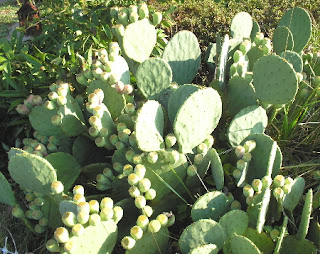
I don't dance around my prickly pear cactus. But I do like to look at it. I can look at the prickly pear in my yard and watch the seasons change.


In late spring, the pads (called cladodes) sprouted an abundance of yellow blossoms. Unfortunately, I forgot to take a picture of the blossoms this year. The above picture was taken a week or so before they bloomed.

Later in the summer, the fruit looked like toes.


Finally, on this warm October day, the fruit has turned maroon, a proper autumn color.


To some, a prickly pear is a weed; I think it’s a flower. I’ve had mine over a decade. A friend in Roanoke gave me some pads which quickly took root and flourished. When I left Roanoke, I brought some pads with me. They took root and flourished, too. They’ve been flourishing (spreading!) here since 1999

My husband likes to eat the fruit. He says it tastes like beets. I’ve tried it but didn't care for the taste. Some people eat it, though, and some make jelly from it.

I just like to look at it.

Prickly pear is mentioned in another poem—but not in a flattering way.


Labels: