Peevish Pen

Ruminations on reading, writing, genealogy and family history, rural living, retirement, aging—and sometimes cats.

© 2006-2025 All rights reserved

My Photo
Name:
Location: Rural Virginia, Virginia, United States

I'm an elderly retired teacher who writes. Among my books are Ferradiddledumday (Appalachian version of the Rumpelstiltskin story), Stuck (middle grade paranormal novel), Patches on the Same Quilt (novel set in Franklin County, VA), Them That Go (an Appalachian novel), Miracle of the Concrete Jesus & Other Stories, and several Kindle ebooks.

Saturday, August 10, 2013

Not for the Claustrophobic

This post is about health matters—no kitties.

Yesterday, I had a new experience—an MRI. For the last couple of months, I've been plagued by leg pains, sometimes so bad I have trouble walking. Finally I convinced my doctor to refer me to an orthopedist, who diagnosed my problem as sciatica. Because X-rays don't show nerves, he recommended  an MRI. Yesterday I went to at Carilion Franklin Memorial to get one.


I'm glad the long tunnel-like entrance has grab bars on both sides. I couldn't have walked it without them.


Once I was inside, things moved pretty fast.

"Do you have claustrophobia?" the nurse asked. I said no, but then I couldn't think of a time when I'd been trapped in a small area. She asked other questions—did I have implants, piercings, tattoos? Again, I answered no. Then I was good to go.

Because I'd Googled what to expect, I wasn't apprehensive. I followed the nurse to the portable MRI unit out back.


We stepped onto a platform, which raised us to the level of a garage door-type thingie, which opened into a room with computers. I deposited my glasses into a basket and went through a door where the actual machine was. Since I'd worn clothing with absolutely no metal, I didn't have to take off anything.

After lying down on a table, having some pillows adjusted and getting earphones (I opted for classical music), the table moved backward into a kind of tunnel-like thingie—like a pod that might transport me to outer space, or something like that. It was a close fit. Then the part over my head got closer. Definitely not for the claustrophobic. But it wasn't bad.

I lay still as death and listened to a Mozart concerto while the machine clunked, banged, jack-hammered, and hummed. The technician had told me it would sound like a car wreck in slow motion. He was right. I thought how being in the contraption was probably not unlike being in your coffin while shovelfuls of dirt where tossed onto you. A coffin would likely have more room, though—and most likely no Mozart.

Then I thought how being inside the contraption was not unlike being in a womb where, while waiting to get born, you had to listen to various noises in the outside world but you couldn't do anything about them.

Then I didn't have time to think about anything else because the noise stopped and I was delivered feet first into the world.

The technician showed me some of the scans on the computer screen. I can honestly say it was a side of myself I'd never seen before.

The scans will be sent to my orthopedist; I'll find out his conclusions next week. Stay tuned.

Meanwhile, if you want to see what getting an MRI entails, there are a bunch of You-Tube videos that explain the procedure a lot better than I did. Here's one: http://youtu.be/DZTXa4qerI4?t=5s.

~


Labels: ,

Saturday, July 20, 2013

Drug Habit

No cute kitty pictures or farm pictures today—just an update about my health, which hasn't been good lately:

Lately my drug habit has increased. Now I'm shooting up every night. With this:


The prandin I'd been taking to help with diabetes control wasn't doing its job. My blood sugar levels were too high—rarely below 150 and often over 200. So I started on 10 units of a long-acting insulin at night. Above, encased in a lavender book-like thingie, is the pre-loaded insulin pen I use. The green things in the circle are disposable needles that attach to the pen.

After my insulin pens came (surrounded by ice packs and packed in a large box), I made an appointment with Tonya, the diabetes nurse at my doctor's office. She gave me a lot of diabetes-related stuff, including a supply of needles (which, oddly, don't come with the pens) and the lavender book-like thingie that holds pens and needles. My glucometer was several years old, so she gave me two new ones to see which I liked better.


Using a model of some human flesh, she showed me how to inject. Then I practiced on the disembodied plastic flesh. Two decades ago, I'd had to inject insulin into my diabetic labradoodle—a process that started with filling a needle from a bottle of insulin—and this seemed a lot easier. I was pretty sure I could inject myself with no problem.

I was right. But even after a few days, I still have to follow directions in the manual to make sure I'm doing it right. 


I'm relieved that the injections don't hurt at all and the needles are really tiny. The best thing is that my blood glucose levels have dropped about 40 or 50 points—not as much as I would like, but enough to make me feel more energetic and less fatigued.

A diabetes drug habit is expensive. Test strips are about 50¢ each, and I test three or four times a day. My co-pay for a three-month supply of prandin is over $60, with Medicare and my supplemental insurance picking up the rest. I have no idea how much the pens and needles cost.

But I'm glad to be feeling better. Now, if I can just get the muscle pain problem resolved so that I can walk better. . . . Consequently, I have an appointment with a rheumatologist next week.
~

Labels:

Thursday, November 15, 2012

Diabetes Day

Warning: Blatant heath info. 

Yesterday—November 14—was World Diabetes Day, which pretty much passed unnoticed in my region. Folks around here didn't sport blue ribbons (blue is the diabetic color), nobody held a race or even a walk, there wasn't even a benefit concert.

My glucometer reading an hour after lunch today.
Yeah, it's too high. I ate too many carbs.

 For me, every day is Diabetes Day and has been since I was officially diagnosed in January 1999. That was when my gynecologist told me I was diabetic; my family practitioner had told me a few years earlier that my extreme fatigue, weight gain, brain fog, and aches and pains meant I had fibromyalgia.  After all, I didn't have the symptoms that most folks think signal diabetes: I didn't lose weight (I gained!), I didn't make frequent trips to the bathroom (I was a teacher; I'd trained myself to hold it.), I wasn't especially thirsty (Again, as a teacher in the age before bottled water, I couldn't drink water whenever I wanted.)—so I couldn't have been diabetic.

Finally, my family practitioner gave me a finger-stick blood test (92—not diabetic!) but also had me take the A1C test that showed, yeah, I was diabetic. Really diabetic. I searched the Internet for diabetic info. I realized that other symptoms I had were also diabetic symptoms: the dirty skin syndrome on my neck and other areas, skin tags, decreased vision (I needed progressively stronger lenses every year), frequent infections (I attributed all those strep infections to being around students with strep throat, plus there was the 22-month bout of chronic Epstein-Barre), numbness and tingling of hands and feet (diabetic neuropathy), itchiness, and slow healing cuts (even minor scratches). My Internet search led to discovering Dr. Bernstein's Diabetic Solutions. Using practices in the book, I took my blood sugar back into the normal range and lost weight. Through the years, I started eating like regular people again (although not as much carby stuff as the food pyramid recommends). And my diabetes became much worse and I gained weight again.

This year, I have made a bigger effort to get control. I've cut the carbs way back. Giving up wheat has helped tremendously, although sometimes I backslide.

What's it like to have diabetes?

I can tell when my blood sugar is rising too fast or too much (or when it's  over 140)—my ears ring. Not jingly-jangly, but the insect-sound of a hayfield in summer. It's not unpleasant, but I have trouble deciphering sounds if I'm not looking at whoever's talking. If there's another sound in the background—music or general background noise, I really have trouble understanding whoever is talking to me. I try not to use the phone during these episodes because I can misinterpret info. Sometimes I'll tell the caller to speak louder and slower. When my blood sugar is high, I'm sluggish, klutzy, and brain-foggy. One doctor described it to me as "walking through thick syrup." That description nails it. Besides the hearing problem, high blood sugar makes it harder for me to concentrate and harder for me to make my hands to do what I want them to do (like handwriting or opening a jar); I really want to sleep. Plus, I'll hurt.

If my blood sugar rises too high too fast, it'll crash in about two hours. I'll get jittery, feel faint, and sometimes break out in a cold sweat. I'll also become very irritable. The ear-ringing will stop, but other noises will bother me—especially certain frequencies. I'll be easily distracted.

After a higher-than-usual-carb day or a day in which I ate something containing wheat, I pay the price. I'm tired, my muscles and joints ache, and I usually have difficulty walking. My hands tingle and sometimes won't work the way I want them to. If I'm going to be at an event where I'll be tempted to eat too many carbs, I try to not schedule other activities for two days afterwards so I can bounce back. I won't drive long distances or at night. I won't do things that require intense concentration or fine motor skills.

I've tried many diabetic meds that didn't work. For the past year year, I've been on prandin, which I take 15 to 30 minutes before a meal. As long as I keep my carb count to under 20 grams per meal and avoid wheat, potatoes, rice, soy, processed foods with their plethora of additives, artificial sweeteners (which act just like sugar as far as my blood sugar is concerned), I generally do OK. I eat full-fat rather than low-fat, because fat acts an an appetite suppressant and helps brain activity. I eat protein as well as fat with every meal. Fat and protein don't spike my blood sugar the way carbs will.

I try to avoid temptation, which means I sometimes turn down invitations to places where I suspect I won't be able to stay wheatless and low-carb. I appreciate buffets instead of pre-selected menus because I can almost always find what I need to eat from buffet choices. I appreciate groups that save the carb-laden treats to be served at the end of a meeting, so I can leave instead of watching other folks scarf up what I really  really want  but know I shouldn't eat. I appreciate get-togethers where there are other choices besides carbs—cheese cubes, raw vegetables, etc.

I don't appreciate having no choices. I dropped out of AAUW a few years ago because the luncheon meetings had such delicious carb-laden food (no choice—everyone ate the same entreee) and desserts to die for (literally!) I still go to Pen Women luncheons because I can brown-bag it or order for myself. I sometimes avoid other occasions if I know there'll be carby treats (and no other choices) and if I don't have someone to drive me home afterwards. I don't buy Girl Scout cookies or doughnuts or popcorn that groups are selling as fund-raisers. I don't go to pancake breakfasts or spaghetti suppers no matter what good cause they're supporting.

I have become my own cause.
~


Labels: ,

Sunday, November 04, 2012

Diabetes Awareness

November, according to the American Diabetes Association, is American Diabetes Month®. (That's right, the name is registered. If you're not American or not diabetic, I guess you can't celebrate.) I am not a fan of the ADA because they disseminate too much misinformation—such as encouraging diabetics to eat according to the food pyramid instead of low-carbing. Diabetics can't process carbs, so it makes no sense to encourage them to eat lots of carbs.

The ADA doesn't even explain how a diabetic should properly draw blood. On the ADA website, a picture shows the pad of the finger used for a finger stick. This is painful. You should use the side of the pad, not the center. Why doesn't the ADA know that?

Here's some more misinformation from their web site:

"A healthy meal plan for people with diabetes is generally the same as a healthy diet for anyone – low in fat (especially saturated and trans fat), moderate in salt and sugar, with meals based on whole grain foods, vegetables and fruit."

 . . . and:

"Starchy foods are part of a healthy meal plan. What is important is the portion size. Whole grain breads, cereals, pasta, rice and starchy vegetables like potatoes, yams, peas and corn can be included in your meals and snacks. The key is portions. For most people with diabetes, having 3-4 servings of carbohydrate-containing foods per meal is about right. Whole grain starchy foods are also a good source of fiber, which helps keep your gut healthy."

I know from personal experience, as well as doing a lot of reading, that starchy foods and whole grains—carbs!—will cause my blood sugar levels to soar, will make me ache and bloat, and will cause other problems. Anyone who has read Wheat Belly by Wm. Davis, MD, knows that whole grains will not "keep your gut healthy" and will cause numerous health problems.

I used to eat low-fat, plenty of fruit, and lots of whole grains (and potatoes, corn, etc.). I also wasn't eating beef or pork. I got fat and felt lousy. But I was eating according to what was healthy—and what the ADA still recommends. Here's how I looked then in my 1997 retirement picture: 


I'm pretty sure I was diabetic when the above picture was taken, but I hadn't been diagnosed (and wouldn't be until nearly two years later). I had been diagnosed with fibromyalgia (a catch-all term for "yeah, there's something wrong with you, but we don't know what") after my two-year bout with chronic mono. I had extreme fatigue, autoimmune problems, numerous infections, etc. Notice I needed a cane to walk back then.

Here I am a few months ago, about 55 pounds lighter than I was in my retirement picture:


Keep in mind that the ADA receives substantial contributions from Big Food, and Big Pharma. Naturally the drug companies don't want you to get better on your own. If you didn't need their drugs, they'd lose money. Big money.

If you're diabetic, or think you might be, there are three books you need to read. The information contained in them is far superior than any info you'll find on the ADA website:
 I've mentioned these books in earlier blog posts. I've also mentioned in an earlier post about why I dropped out of a diabetes class (based on ADA info and the infamous food pyramid).  But, I recently received this in the mail:


Since the same nutritionist who conducted the diabetes class is conducting this, I won't be attending. I don't need any more misinformation.

If you're diabetic—or think you might be—it's up to you to find out what does and doesn't work for you. Those three books are a good place to start.
~

Labels: ,

Thursday, May 24, 2012

Bouncing Back

Warning: Health matters. Boring. But I'll post some pics of my flowers to relieve the monotony.

In February, my diabetes had gotten out of control, and I felt lousy. My A1C was 10, which meant my average blood glucose level was around 250 to 275, depending on which chart you consult. I had low energy, and I didn't walk well. Last fall, I'd gone off glyburide because it wasn't helping, and my BGs were always above 200—sometimes 300. I cut my carb consumption a bit, but apparently not enough.


I signed myself up for a diabetes class, which was a major waste of time and filled with misinformation. I eventually dropped out, but I read a few books that maybe saved my life. At least they improved it. Those books, which I've mentioned upstream in this blog, are Wheat Belly, by William Davis, MD, and two books by Gary Taubes—Good Calories, Bad Calories and Why We Get Fat.

Since making some changes in medication and what I eat (or don't eat), I've gotten better. A lot better. I started taking Prandin, which didn't cause me the problems that other diabetes drugs had in the past. (Years ago, Metformin caused bad muscle aches; Januvia put me in the hospital with breathing problems plus high blood pressure, Glyburide didn't seem to help and occasionally made me shaky.) I cut my carb intake severely and eliminated certain foods that might be a problem.

                                       
My A1C dropped to 7.3. That means an average BG level of 163-183 (depending on which chart, etc.).  I've dropped 20 pounds. My energy level is higher. My cholesterol levels have improved slightly. HDL has gone up; LDL has gone down.

I can walk faster and for longer periods of time. My balance is better. My leg pains are mostly gone. I still have trouble sitting for more than a half hour, so long car rides are out of the question for a while. I've noticed that I can almost make it to Roanoke before numbness and tingling start in my hands and feet. If I can stop and walk around a bit every 40 miles or so, I'm OK.


What I try not to eat?

Wheat: This meant giving up bread, pasta, etc. I'd already cut way back, so this wasn't much of a problem. Once in a while, I allow myself a cookie,  but it has to be a really good cookie. Problem: wheat is in so many things, so I can't eliminate it entirely. But eliminating most wheat also eliminated my acid reflux and occasional bloating.

Potatoes and rice: I gave these up long ago. Potatoes—besides spiking my BGs—gave me bad muscle cramps. Sweet potatoes didn't give me muscle cramps, but my BGs shot upward when I ate them, so they had to go. Rice has always spiked my BGs.

High fructose corn syrup: This stuff is in so many things, though, that I still ingest some. But not as much as I used to.

Most processed/prepackaged foods: I've given up the convenience of microwave foods that have all sorts of additives. I'm trying to eliminate additives—especially high fructose corn syrup.

Artificial sweeteners: Aspartame gives me bad back-of-the head headaches, so I eliminated that long ago. Others, such as Splenda, raise my BGs substantially—just like sugar does.

Most fruit: Fruit is sugar, and it raises my BGs considerably. I occasionally eat blueberries or strawberries, but not very often. When the apples on my tree are ripe, I'll eat an apple while I am walking around.

"Fake" food: Margarine is something I avoid. Ditto many oils (What the heck is a canola anyhow?).

Soy: Thanks to Monsanto, the soybeans planted in the USA are Round-Up resistant. I don't care to eat Pesticides. Like wheat, though, soy seems to be in a lot of things.

Soda—either regular (sugar/HRCS laden) or diet (artificial sweeteners). I eliminated soda from my diet years ago. I don't miss it.


What do I eat?

Low-carb vegetables: I love broccoli and cauliflower. Ditto the kale and mustard greens I grow in my little garden. I also eat cabbage, eggplant, brussel sprouts, yellow squash, zucchini, spinach, green beans, and a few other low-carb veggies. Kale chips are my favorite snack.

Eggs: A minimum of three a day.

Meat: Especially steak or other red meat, which is loaded with nutrients. And bacon. Every morning begins with a bacon and eggs breakfast. I occasionally eat chicken but rarely more than once a week.

Butter, olive oil, and coconut oil.

Coffee: Black. Three to four cups a day. Maybe more. Sometimes tea.

Sparkling water: Satisfies my taste for something fizzy. I like LaCroix and Perrier.

A little ice cream: Preferably natural flavor with a high fat content and few additives.

Almonds: But just a few a day.

Basically, I eat few carbs and more fat and protein. I don't count calories, just carbs. I always have a full plate at each meal and eat until I'm satisfied. Because I eat high fat, I rarely get hungry between meals. (I do not follow the American Diabetes Association's advice to eat according to the food pyramid.)


Do I exercise?

I don't go to the Y or a gym. I consider activity—such as housework, gardening, yardwork, and horse/dog walking—as my exercise. 

I've bounced back considerably in less than four months, but I still have a way to go yet.
~

Labels:

Thursday, March 29, 2012

Flaxseed Wrap

Since reading Wheat Belly, by William Davis, MD, I've stopped eating wheat products and feel much better. Some folks have asked me what I eat for bread if I'm not eating wheat. The book contains a recipe for a flaxseed wrap that substitutes nicely for bread. It tastes good and is filling.  Here's what you need to make it:

3 tablespoons ground flaxseeds
1/4 teaspoon baking powder
1/4 teaspoon onion powder
1/4 teaspoon paprika
Pinch of sea salt
1 tablespoon coconut oil
1 tablespoon water
1 large egg


Mix together the ground flaxseeds, baking powder, onion powder, paprika and salt in a small bowl.


Stir in the 1 tablespoon coconut oil. The oil is solid at room temperature, so you might want to heat it slightly. The mixture will be a little thick.


Beat in the egg and 1 tablespoon water until blended. That thins the mixture.


Grease a microwave-safe plate with coconut oil. Pour in the batter and spread evenly over the bottom. I use a fork to sort of comb the mixture out from the center. 


Microwave on high for 2 to 3 minutes until cooked. I microwave it for 2 minutes and 20 seconds, but your milage may vary. Let cool for 5 minutes.


Then you have this.


Slide a knife or spatula under it to loosen it from the plate and turn it over


The result works great as a wrap—I've used it to make a tuna salad wrap and a sliced chicken wrap—but it's good just as bread. I added some butter (I never use margarine or whatever a "spread" is) . . .


. . . and fold it over. The result is big enough for two servings if you slice it crosswise. And it's goooood! 


Here's the recipe that I found online, but it's also in the book:


This flaxseed wrap has about 6 grams of carbs, as near as I can figure. If you like, you can also make these wraps ahead and refrigerate them. Besides using a wrap for a hunk of bread or a sandwich wrap, you could probably put some pizza toppings on it.

I haven't tried it that way yet, but I'm thinking about it.
~

Labels: ,

Tuesday, March 27, 2012

Diabetes Alert Day

Today, March 27, is the American Diabetes Association Alert Day. I have no faith in the American Diabetes Association because it promotes an unhealthy (high carb!) way of eating for diabetics. The "food pyramid" way of eating—low fat and high carb—is NOT good for diabetics. (I've blogged about that here and here and here.) The ADA should alert diabetics about the dangers of eating high carb. It doesn't.

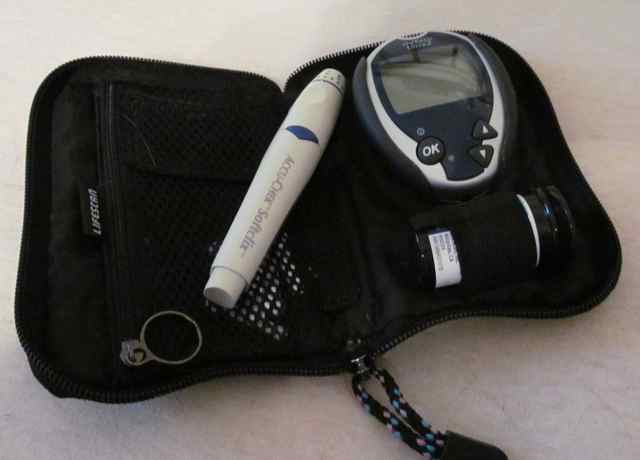
Eating a high carb meal shoots up the blood sugar (blood glucose) level. I'm aware of what food affects my blood sugar levels because I sometimes check my blood sugar at least twice a day with my glucometer—and more often if I've eaten something that I don't usually eat. I also check after I've eaten something new. There are several different glucometer kits available, but my kit that looks like this:


The kit consists of a meter, a clicker-thingie that contains a disposable lancet, and some testing strips. Here's a close-up of a strip and its container:


You insert the strip into the meter. When it's ready, it displays a picture of a strip to tell you it's ready for you to add a drop of blood to the strip's end. 


You get the blood from your finger. The trick is to prick the side of your finger tip and not the pad. Pricking the pad, which has a lot more nerves, hurts. Using the side of the pad doesn't hurt.


You only need a small drop of blood. The clicker has an adjustable feature to let you dial it to a depth that works best for you. On this clicker, I'm a 2. Then you press the button (the blue thing on the side of my clicker) and it automatically pricks. Touch the strip to the drop of blood, and you get your reading in a few seconds.


This reading—118—is actually pretty good for me. It was taken about three hours since I had breakfast. (In early February, my readings were usually over 200.) Normal fasting blood sugar is from 70 to 100. I'm still working—by low carbing, taking prandin before meals, and avoiding any food that contains wheat—to get my blood sugar down. 

Also, thanks to low-carbing and wheat-avoidance, I've lost weight. Getting weight down by at least 10 pounds is supposed to improve blood sugar levels. I've lost over 10 pounds so far, but but I still have a way to go. I don't count calories (mainly a waste of time, according to Gary Taubes) or eat low fat (which, despite all the hype, doesn't help much with weight loss unless you starve yourself).

The neat thing about this meter is that it will average blood sugar in increments of 7, 14, and 30 days. In early February, my average was over 200. By February 9, I'd gotten the week's average down to 195. Today, my averages are 137 (7 days), 146 (14 days), and 153 (month).


I'm getting better, no thanks to the American Diabetes Association and their misinformation. 

Just wanted to alert you about the ADA.
~

Labels:

Wednesday, February 29, 2012

Wheat Belly

Wheat Belly: Lose the Wheat, Lose the Weight, and Find Your Way Back to Health, a best-seller by William Davis, MD, answered a lot of my questions about what foods a diabetic should eat. Short answer: not anything containing wheat.


I already knew that eating bread—and other things containing wheat—made my blood glucose levels soar above 250 and caused other problems, such as bloating and fatigue. What I didn't know what just how much damage wheat consumption could cause.

Davis, a cardiologist who gives the name "wheat belly" to the excess abdominal fat that wheat eaters have, believes wheat consumption (and gluten sensitivity) is responsible for a variety of ills—not only celiac disease, but also obesity, high blood sugar levels, asthma, liver diseases, thyroid problems, some cancers, dementia, rheumatoid arthritis, seizures, allergies, lupus, IBS, Chrohn's disease, and others. Wheat consumption even affects the aging process.

According to Davis, the wheat we have now is vastly different from the wheat of a half century ago. In the first part of his book, he goes into great detail and traces the history of wheat from Biblical times to the present. Part Two of his book explains the connection between wheat and various health problems. Part Three explains how to create a wheat-free life. And he includes recipes.

Like several others (for instance, Gary Taubes, author of Good Calories, Bad Calories and  Why We Get Fat), Wilson takes issue with the American Diabetic Association recommendations that promote low-fat, high carb eating. For instance, from page 156:

Low-fat diets are not benign. The high-carbohydrate, plentiful whole grain intake that unavoidably results when fat calories are reduced triggers higher blood glucose, higher insulin, greater deposition of visceral fat, and more VLDL and triglycerides. . . .

While Wheat Belly is written in an informal engaging style, it is nonetheless packed with annotations, references, and end-notes. Davis cites numerous sources to support his premise.

If you'd like to learn more about the "wheat belly" idea without reading the book, here's a relatively quick way. In two YouTube videos, Dr. Davis explains his ideas. Each video is about 20 minutes. Here's part I:


Here's part II:


During the three weeks since I read Wheat Belly, I've mostly eliminated wheat from my diet as well as  lowered the amount of carbs I eat. Eventually, I hope go completely wheat-free, but wheat seems to be in everything. In the three weeks I've (mostly) been off wheat, I've lost about five pounds and no longer have acid reflux. My blood glucose levels have gone down substantially. Though not as low as I want them to be, my BG gets lower than 130 on most days (from a high of 250+) and I hit 114 yesterday—my lowest in I don't remember when.  I have a lot more strength, stamina, and energy.

If you're diabetic or you have other health issues, you might want to take a look at Wheat Belly. Can't hurt, might help.

Labels: ,

Wednesday, February 22, 2012

Misinformation

Warning: A rant. No cute kitty pictures or nature pictures today.

A few weeks ago, I posted about upgrading some things in my life, including my physical condition.

Because I'd fallen off the low-carb wagon and my diabetes had gotten a lot worse, I signed up for a diabetes management class. I was hoping to learn some good low-carb recipes, some info about recent developments in diabetic research, more about how the glycemic index works, some good books about diabetes management, etc. Also, I'd started a new diabetic drug—prandin—and I wanted to learn more about it. I also needed motivation to take charge of my diabetes.

Of the three classes so far  in the six-class program, none has addressed my concerns. These first three classes have been about following the food pyramid and eating low-fat foods. Years ago I learned that the food pyramid wasn't healthy for diabetics and that I couldn't eat the recommended 45 to 60 carbs per meal without having my blood sugar levels go way over 250 (normal is 90-100). I knew that experts in the diabetic field—such as Richard Bernstein, MD, and William Davis, MD—didn't believe in the food pyramid or the high carb diet that the American Diabetes Association recommends and which doesn't work for diabetics.

At last Friday's class, we were given a handout called "Eat Less Fat." It was originally prepared by the University of Georgia Cooperative Extension in 1996. It looked sort of like a coloring book and  was loaded with misinformation. Here are some of the pages:


Eating dietary fat doesn't necessarily make you fat unless you eat a lot of it. Fat is one of the three sources of energy, the others being protein and carbohydrates. (In fact, some medical personnel are starting to recognize benefits of a ketogenic diet.) Carbohydrates—not fat—are the problem for diabetics. See Chapter 9 of Dr. Berstein's Diabetes Solutions book for more detailed info. 


No way will I ever spray this stuff onto pans that touch my food. I'm trying to avoid "chemical" food and eat more natural stuff.  I'm pretty sure the propellent used in the aerosol isn't natural. (Pam, the leading brand of non-stick vegetable oil sprays, uses propane, isobutane and n-butane as propellant gases.) I looked at the Pam label in the grocery store yesterday. One of the ingredients listed was silicon.  


I won't do this. Lower fat means higher carbs. As I mentioned earlier, diabetics have problems processing carbs. I know I do. See Chapter 10 of Dr. Berstein's book for more info.


Corn, butter beans and peas are all high carb vegetables! Some diabetic experts—such as Dr. Bernstein—have them on the diabetics' forbidden food list. Margarine is a chemical concoction, and some of the oils in margarine are from genetically modified crops (canola, for instance). I don't care to eat a helping of something grown with Monsanto's Round-Up. (More info about margarine is in Enig and Fallon's article, "The Truth About Fats.")


Arrgghhh! Potatoes are one of the worst foods for diabetics! I love potatoes, but eating them makes my legs and arms ache and my blood glucose levels soar. 

Consequently, I'm taking charge of my diabetic problems. I'm ignoring the this handout and the other misinformation from the class (and from the Amierican Diabetes Association!) and embarking on other ways to manage my diabetes. 

More about what I'm doing—and how I'm doing—in upcoming posts.
~


Labels:

Monday, February 23, 2009

Doing a Little Better

Warning: Boring health stuff and a graphic cat incision picture.

The three of us are doing a little better—Cupcake the horse, Foxy the cat, and I.

In November, Cupcake had problems eating and I had to wet down her pellets to make soup. Now, she's been upgraded to gruel and eats much faster. She has a lot of pep for a mare who's pushing 28. She now nickers to me.

I'm doing better with my diabetes. I'm still sticking to less than 100 grams of carbs a day, and my blood sugar has dropped from a monthly average of 204 five weeks ago to 160 today. (My glucometer has this nifty little feature that computes averages.) I've dropped seventeen pounds, although I still have a lot to go.

I haven't been walking lately because of the cold and strong winds. Also, I'm having some lower leg problems. Two months ago, I had problems with swelling and leg cramps. Now, I've got aches, not cramps, and they're below the knee. But my legs now really hurt if I walk too much, and I wake up with them hurting. The swelling isn't as bad as it once was, but it's still a problem, and I don't have as much stamina as I'd like. But a lot of the all-over aching is gone. And I have an appointment with an endocrinologist in late April—the soonest I could get one. I have a feeling I have some thyroid problems that can be fixed.

But I'm better and I have more energy. I've even begun to tackle some long-neglected house-cleaning.

Despite the loss of some leg muscle, 10-year-old Foxy is walking very well. She hardly limps. She can get onto my bed, where she's decided to sleep. I have problems getting her medicine down her—she's a big, strong cat who puts up a fight—but I get most of it down her. The top part of her incision looks really good where the fist-sized fibrosarcoma was removed and the bottom part isn't bad. The vet thinks he got all the cancer. She really wants to go out, though, and can't understand why the other cats can and she can't.

Here are two pictures of Foxy (Warning: the second one shows the incision):


The three of us—horse, cat, and woman—are all senior citizens, so some health problems are to be expected.

But we're doing better.
~

Labels:

Saturday, January 17, 2009

Gaining and Losing

This is kind of boring. You might want to skip this post unless you like to read about health problems.

I lost ten pounds in two days!

That’s not quite true. It was actually twelve pounds. But at the doctor’s office on Wednesday, I had on shoes when I weighed.

I’ve had some health problems lately —weakness, fatigue, leg cramps (especially at night), poor concentration/confusion, and an earache that won’t go away. During the past couple of weeks, I couldn’t manage even short walks with the dogs. Getting through Kroger’s to shop was a challenge. My legs usually swelled like crazy by late afternoon, and at night painful cramps and muscle contractions woke me up.

Two weeks ago, I arrived at my doctor’s appointment with a list of my symptoms, in case the confusion kicked in while I was there. I’d listed the earache first, so that’s what she dealt with, although she did order some blood work since I’d thought to come in fasting. She gave me a prescription for drops which not only didn’t help, they made my ear itch. (Maybe the itching was supposed to distract me from the pain.)

This past Wednesday, I went back to deal with the next item on the list. The nurse who took my blood pressure had the print-out of my lab results. I asked to see them. Before the doctor came in, I knew what my problem was.

Some background here: I was first diagnosed with diabetes in January 1999 by my gynecologist who noticed certain symptoms and thought I should be tested. My GP at the time had missed it, no doubt because I’d had 22 months of chronic mono, then fibromyagia (a diagnosis of which means “We know something is wrong, but danged if we can figure out what”), and some other problems.

At that time, my A1c test was 8.8. (Normal is under 6; 10 is very high.) My GP sent me to diabetic class where I learned to use a glucometer and was told I could eat 60 grams of carbs per meal and that we’d aim for an A1c of 7. I’d have to exercise, etc.—and if that didn’t work, we could try some drugs. The class was basically a waste of time. I got better info from the Internet.

From Internet research, I learned that low-carbing would reduce both an A1c and a too-fat body. I ordered a book, Dr. Bernstein’s Diabetes Solutions, and cut my carb intake to less than 30 grams of carbs per meal. I stopped eating pasta, potatoes, rice, and white bread. I lived near the Salem Y at the time, so I signed up for arthritis water aerobics (the regular kind was too strenuous). Within six months, I’d lost 40 pounds. Within a year, I’d lost another 15 pounds and had brought my A1c to 5.6—normal.

In August 1999, we’d moved to the farm, so I walked twice a day with my two dogs—my first border collie and a mixed retriever. I briefly tried the Y in Rocky Mount, but the water was too chilly, the smell of chlorine too strong, and the music too loud. I left each session with a headache and the shakes. Walking was better: I wasn’t inhaling chlorine, it was usually quieter, and I didn’t get a headache. Plus, the dogs were good company.

Gradually, though, I slipped off the low-carb wagon. I started adding more carbs, having more desserts, rediscovering the joy of macaroni and cheese. I upped my carbs to 60 grams a meal and started regaining weight.

Because I wasn’t walking much lately, I figured my blood glucose levels might be rising. I’d stopped testing my blood a while back; our insurance no longer covered the strips—which were pricey—and I’d been getting normal readings for a while. I attributed my increasing aches to advancing age. After all, I could look at my hands and see how arthritis had reshaped some of my fingers.

For years, my A1c stayed under 7. Then—a couple of years ago—it hit 7 again, then 7.9. I tried a couple of drugs—a couple of years ago, metformin gave me horrible muscle cramps (I learned later about lactic acidosis affecting some users); glyburide gave me shaky spells and cold sweats; Januvia (which my doctor touted as very safe but it's made by Merck, the company that produced the infamous Vioxx) put me in the hospital with breathing problems in September 2007. (TV ads for Januvia now mention that people with respiratory problems shouldn’t take it.)

Consequently, because of some drug allergies I have and my experiences with diabetes drugs, I’m wary about taking the metformin the doctor insisted on Wednesday that I should take, even though I tried to convince her that metformin did more harm than good the last time.

When I saw my 10.4 A1c Wednesday, I knew why I’d felt so lousy. Consequently, Wednesday night, I started low-carbing again. Actually, I didn't eat anything Wednesday evening. By Thursday night (chicken breast and green bean casserole for both lunch and supper), I felt better (except for the earache). I had strength to open the sliding glass door, which I hadn’t been able to easily do for a while. I could carry a loaded laundry basket the length of the house. I could do more around the house.

By Friday, I’d lost ten pounds—I figured most of it was fluid because my legs aren’t swelling as badly.

Now, I need to lose several points on the A1c scale. I need to lose weight. I’d like to lose the earache, but it’s gotten better since I’ve been laying my head on the heating pad a couple of times a day.

And I probably need to lose that bottle of metformin that’s sitting unopened on the kitchen counter.
~

Labels:

Wednesday, February 06, 2008

Maintenance

In the last week, I’ve been to three different medical appointments, mostly for routine maintenance–something I need more of as I age. I have concluded the following:

  • Watching a sonogram of the interior of a personal private part is boring. (Note: Boring is apparently a good thing.) I noticed a lot more action on my electrocardiogram last September. My conclusion: some body parts are more entertaining than others.
  • Having toenail surgery is almost as bad the second time around (the second time in seven months!) and I limp just as badly as after the first one. Luckily I got a lot of yard work done Sunday when the weather was nice and I could walk better. I wish someone had warned me about ingrown toenails being a part of aging.
  • Mammograms at Franklin Memorial Hospital are much more comfortable than those done at Lewis-Gale (thanks to a foam pad the radiologist places between the patient and the cold X-ray machine), I don’t have to walk as far to get to radiology, and the radiologist evens gives you a souvenir—the pad which can be used for all sorts of craft projects (it's like the stick-on foam craft stuff you get at Wal-Mart). Plus the wait is much faster than at Lewis-Gale. You're in and out in minutes.

I try to get the routine maintenance stuff done during the winter when I usually can’t get out much anyway and won’t miss anything. However, I missed two days of nice weather this week because of appointments.

Next thing: pet maintenance. The horses and most of the cats and dogs get their shots during late winter and early spring. Emma—the mixed sheltie with bad hair—will get her first shearing that will last her until late summer. After the animals: house and yard maintenance. I want to plant a lot of flowers and trees this year—especially forsythias. The woman who designed this house used to have a whole row of them along the road, and they were gorgeous every March. I also want to plant a lot of trees.

There’s always something.

Despite the groundhog’s prediction, the weather lately has been so spring-like. Yesterday’s temperature, for instance, hit 70. Today we had a heavy “spring” rain.

Labels: