Yesterday,
I joined three other self-published authors (
JB Bonds—who is actually Brenda Rowell and her sister Jane),
Sally Roseveare, and
Kimba Dalferes) to present a program on self-publishing at the Westlake library.
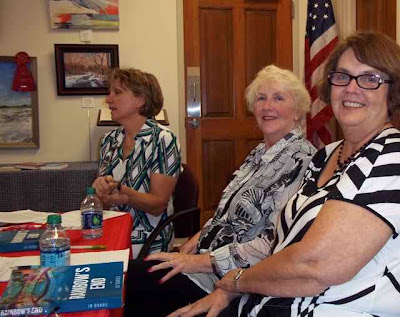 |
| Kimba, Jane, and Brenda. |
I was surprised how many folks—mostly retirees—turned out.
Apparently a lot of Smith Mountain Lake area people have written, or are in the process of writing, books.
We had a great discussion, but it ended way too soon.
Anyhow, if you’re wondering about self-publishing, here’s a bit of advice:
Do you really want to self-publish?
Maybe you have a great idea for a book, and you’ve spent months or years getting that idea into manuscript form. You really want to be discovered by a big name agent (not a
scammy agent) who will sell your book to a major publishing house, and within a few months your book will be made into a movie. That’s what you really want, isn’t it? Alas, the odds are against you.
Having your book picked up by a major publisher might happen. It happens every day—but not to everyone. You can spend years querying and/or sending your manuscript out to agents and editors. Eventually, you’ll get replies saying, “Your manuscript doesn’t meet our needs.” You might query a few publishers you’ve found on the Internet, but some of these are
ones you have to beware of. After a few years, you’ll see the writing on the wall—or at least the writing on a wall covered with rejection slips. You will consider self-publishing.
Why do you want to publish?
If your answer is “to share my feelings with the world,” don’t publish. You may “share your feelings” with a select few—maybe friends or family. The rest of the world doesn’t care about your feelings. Make copies for the select few and save yourself some money.
If your answer is “I write just like David Baldacci/Lee Smith/Sharyn McCrumb/John Grisham/insert name of favorite author,” let them publish instead of you. They write just like themselves, too, and they were there first. If your answer is “I have a good story that’s not quite like anything that anybody has written before,” then you want to publish.
If your answer is “I want to preserve local history in a way that no one has done before,” then you want to publish.
If your answer is “I have some family stories that a lot of people—not just my family—can relate to,” then maybe you want to publish.
And there are other reasons why you might want to publish.
However, wanting to publish and being ready to publish are not the same.
Are you ready to self-publish?
If your manuscript had been purchased by a commercial publisher, it would have been groomed for errors in both content and mechanics. Plot holes would have been filled. Characters would be developed. Those little typos, the dangling modifier or two, the wrong tense, all those passive verbs—those little problems would no longer exist.
But if you’re self-publishing, odds are good that unless you’ve got a good eye for style, punctuation, grammar, and syntax—as well as content development, your manuscript could use a little help.
How do you get help?
You need critical readers. No matter how good a mechanic your brother-in-law might be, he probably doesn’t know diddly about writing. Now matter how well read the lady across the street might be—you know the one, she’d just LOVE to read the book she heard that you’re writing because she always wanted to write herself but she just didn’t have what it takes—well, you get the picture. You don’t want to ask just anyone to read your manuscript. Beside, your brother-in-law will probably hate it and the lady will probably love it. So, what do you do?
Find an editor. Be warned that there is no editor certification board. No license exists to prove that an editor can actually edit. Anyone can call himself or herself an editor. The back pages of Writers Digest are full of ads from editors who will be delighted to work with you. You know better to mess with them—maybe you know an English teacher who needs a project for the summer and would just be so thrilled to see her name in the acknowledgments. But be warned that not all English teachers, no matter how much they intimidated you in high school—can actually edit. A background in English helps, but it’s not everything. An editor should have a college degree, though (you have to actually write papers in college) and a good background in literature and at least one advanced grammar class. The editor should actually have edited something of some substance—the PTA newsletter, the junior high newspaper, and the neighborhood magazine that folded after two issues don’t count. The editor should have a bunch of writing credits—ask to see them.
Join a writers group. Before you even think of finding an editor—if indeed you need one—get the kinks worked out of your manuscript in your writers group. If you join two writers groups, odds are good that you’ll get different advice from both of them—and that’s OK. Don’t be afraid to show your manuscript to anyone for fear that they’ll steal your ideas (they have their own ideas). You want input on what works, what doesn’t work, and what to do about what doesn’t work. After a while, you’ll find a couple of individuals with whom you can work. These are not people who tell you how absolutely wonderful your work is; these are nit-picky individuals who have the guts to tell you your participles dangle and your cliché-infested sentences aren’t working and you have an unnecessary adverb after every single verb. These individuals will scream at you, “Show—don’t tell, for goodness sakes!” until you stop telling and start showing. At first you will hate these people (How dare they suggest that your work isn’t flawless!); then you’ll appreciate them. Then you’ll revise your manuscript—probably several times.
Learn to format. Besides getting your writing just right, you need to know how to format. You must be at least somewhat computer literate—or know someone who is. Writing in longhand is passé, although a few still insist—like I used to —that words have to flow from my brain, down my arm, through the black pen I grasp in my fingertips and onto the yellow legal pad/crisp white sheet of paper/handmade parchment made from the skin of an old rival/whatever. Get over it! Let the electrical energy from your brain flow down your arm and through your fingertips and onto your keyboard where words magically appear on the screen. Rewriting on the computer is a heckuva lot easier than rewriting in longhand. Plus it’s faster and easier to read.
Your delete key can be your best friend. Cut and paste doesn’t involve scissors—it’s magic!
Learn how to set indents (no, don’t just hit the tab key!) and how to select a readable font. And for goodness sakes, don’t put two spaces after a period—or any other mark of punctuation— when you word process. That’s typing! And use curly quotes, not those little straight thingies. And know when to use an em dash and when to use an en dash (and figure out how to do it). Never type two hyphens (--) when you mean a dash. And learn to justify your text—real books don’t have ragged left margins. Real books don’t have hyphens when dashes are called for. Real books usually aren’t in a cutesy font. Real books don’t have three exclamation points at the end of a sentence followed by “he exclaimed.”
When your manuscript is as polished as you can make it—and you’re sure you want to do it yourself, you’re ready to investigate printing services. (But first, read about the
top ten self-publishing mistakes.)
Options: Self, POD, & Vanity
A self-published writer has a few options. One is to completely self-publish (lots of money needed up-front for a print run). Another is print-on-demand (via Lulu or CreateSpace). A third is subsidy publishing (aka vanity publishing), but that can be expensive. Victoria Strauss of
Writer Beware defines these terms here.
If you think you can sell at least 1,000 copies,
complete self-publishing might be the way to go. Of course you need an ISBN number (Bowker sells them here for $125 each.) You’ll also need a bar code, but hold off on that until you know what kind your printer wants.)
So, you’ve gotten your ISBN. Now comes the fun part. You find a printer. Finding the right printer is sort of like finding the right spouse. You want somebody compatible, somebody who’ll keep promises, somebody who’ll make you look good. You can’t just go to the nearest bar and pick up a printer.
The back of Writers Digest lists printers who are eager for your business. However, you can’t just pop in on them. They’re a long way away from you. How do you check up on them? And shipping those books will cost extra. The local phone book is full of printers. The catch is that not all of them print books. And quality varies. So how do you know? Your best bet is to check with local printers.
Ask other local self-published writers what printer they used. If their books look lousy, don’t use that printer. If their books looked good, consider that printer. And while you’re asking, find out if they had particular problems with a printer. Did the printer deliver what was promised?
When you’ve accumulated a few names of printers, go visit them. Pop in unannounced just to see how organized they are and if someone can attend to you right away. Is the printing done on the premises? Ask to see other books that they have printed. A good printer will have a wide variety on display. Check the quality of paper. Can you see print through it? Is the printing blurry? Is the book poorly bound?
If you like the quality of the printer’s work, get an estimate. If you’re writing history, you might want hardbound. If you’re writing fiction—or non-fiction that will soon be out-dated—you want soft cover. Soft cover is way cheaper than hardcover.
Will the printer design a cover or are you responsible. Keep in mind that full color costs more than two-color. The more copies you print, the cheaper the price per copy. In general, your asking price per book will be double your first run publishing cost plus 20%. Stores like to have the book’s price already printed on the cover. Usually you will put down a portion of the cost—up to 50%—when you place your order. You will have to pay for everything if full when you pick up the books. (If you plan to sell all your books yourself, get you business license and sales tax number in advance—that way you don’t have to pay the sales tax on your books; If you plan to sell a few books yourself but most you will wholesale to stores who will collect sales tax, then you will pay sales tax on your printing order. Decide in advance what you’ll do.) After you’ve gotten several estimates, make your decision. A few printers (not many—and it costs more) will take hard copy, but most want your work on disk. Usually the printer will tell you how your work should be formatted—or not formatted. A good offset printer will have your books within a month or less.
Do you have storage space for a thousand books? That’s probably the number of your first press run. A thousand books take up about the same amount of space as a refrigerator and you often have to transport them yourself. Mine took up about 2/3 of the back of my pick-up when I picked them up from Commonwealth Printers in Radford.
But full press runs aren’t practical unless you know you can sell a lot of copies fast. Not many folks still self-publish with an entire press run these days. There are other ways to get your book out.
Print-on-demand: Not many folks still self-publish with an entire press run these days. Print-on-demand requires a lot less money up front, and there are lots of print-on-demand services. Currently, the two most popular are CreateSpace and Lulu. These require a bit of skill, but it’s learnable. And they’re way cheaper than a offset press run. [UPDATE: Createspace has been absorbed by Amazon's KDP publishing. What you need to know about formatting and publishing for KDP is here.]
Publishing services: If formatting a book intimidates you, you might want to try a vanity press. Costs vary from reasonable to pricey, depending on the options you choose.
E-books: Publishing via Amazon’s Kindle costs nothing and is fairly easy to do. Amazon is the major retailer for e-books and, thank to the free Kindle app, readers can read Kindle books on their computers, tablets, or smart phones. Other e-publishing sources are Smashwords and Barnes & Noble’s Nook.
At any rate, do research—and know what you’re getting into—before you commit. A good starting point is this article and resource list from self-published author Matt Iden. Labels: publishing, writing




