Peevish Pen

Ruminations on reading, writing, genealogy and family history, rural living, retirement, aging—and sometimes cats.

© 2006-2025 All rights reserved

My Photo
Name:
Location: Rural Virginia, Virginia, United States

I'm an elderly retired teacher who writes. Among my books are Ferradiddledumday (Appalachian version of the Rumpelstiltskin story), Stuck (middle grade paranormal novel), Patches on the Same Quilt (novel set in Franklin County, VA), Them That Go (an Appalachian novel), Miracle of the Concrete Jesus & Other Stories, and several Kindle ebooks.

Saturday, June 03, 2023

Spring 2022 Hay

I never got around to finishing this post about last year's hay-cutting, but it's apropos for what's going on now on the Sutherland Place. So far two fields have been cut and baled this week, but several fields are yet to be cut. A chance of storms has postponed cutting for a while—just like this time last year.

The fields look pretty much alike from year to year.

On a Saturday in mid-June 2022, the last of the spring hay was cut on the Sutherland Place. Part of it had already been cut, raked, baled, and hauled away a week earlier, but forecasts for bad weather had postponed cutting the rest. 

Here's what the fields looked like on that Saturday. A year later, they still look the same.


One of the tractors used for raking:


These last hayfelds are near what used to be William Milton Sutherland's home.  He was the grandson of the original owner, Philomen Sutherland. The house—actually a double-pen log cabin covered in clapboarding—still stands, but parts of it are collapsing, so its days are numbered.


While hay was cut close to the house, a little weedy patch in the midst of the field was left alone. It's where the hearth for the long-gone kitchen was. The kitchen was midway between the side door and the henhouse.


Here's a closer look at the door:


The top of the chimney is missing, and the bottom has collapsed. Part of the cabin's front (the left side, not shown) has bowed out. 

The back of the cabin still looks straight, but looks are deceptive.


Below is what's left of the henhouse.


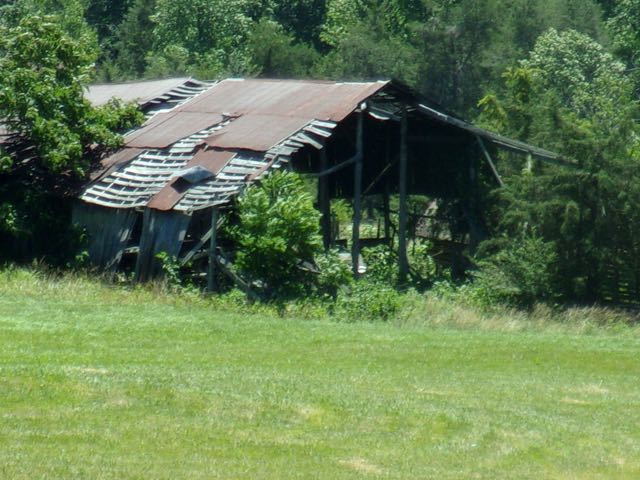
Beside the big hayfield is a large barn that's starting to fall in.


A different view:  


And a closer look:


In its heyday,  lot of hay was pitched into the loft . . .


. . . but the loft is long gone and the methods of making hay have changed.


In the middle of one of the smaller hayfields is what's left of an old tobacco barn. 


Here's a view from the other side.


Looking from the remains of the old tobacco barn, the big barn is at the left and what used to be an equipment shed is farther down the hill. Some of the round bales are beyond the tractor.


Farming has changed a lot since Phil Sutherland arrived in the 1790s with his young bride Fannie; and since Milton Sutherland raised his family in the cabin in the mid-1800s, went off to war, and returned to take up farming—but haying is still done every spring and fall.

~


Labels: , ,

Wednesday, August 02, 2017

Golf Cart Trail Ride

Twenty-five years ago, I used to ride wooded trails on my horse, but those days are gone. I no longer have a horse, and health probems prevent me from walking, much less horseback riding. But this afternoon, I went on a trail ride—via golf-cart.

The part of the old Sutherland Plantation we bought in 2016 has a few trails that my husband has kept clear. Here's the start of one:


It leads downhill to the creek . . . 


. . . and it's below the last house built on the property.


Today was in the 80s, but the woods were surprisingly cool.


We passed ferns and downed trees.


Some of the trees were pretty good-sized.


We also passed where previous owners had dumped appliances, etc.


At the bottom, we came to the creek, which eventually flows into Bull Run, a cove on Smith Mountain Lake. 


Soon the hayfield came into view.


This tree was between the trail and creek. It almost looks like a paw-paw, but the leaves are much bigger.


Finally we came to the bridge, which leads to the fields and an old house. Given the condition of the bridge, we didn't drive across.


From the bridge, we could see the old William Milton Sutherland house. Will Sr. (1821-1899) served in the Confederate army. In the 1900 census, Will Jr. (1859-1942) was the closest neighbor to my great-grandfather, Henry Silas Smith.


The field in front of the house, which is a clapboarded-over double-pen log cabin, looks bluish. That's because the hay-fields were limed today. 


Near the bridge, two trees intertwined and looked like a sculpture.


The trail starting back up:


Just past this stand of trees is a busy road:


The trail ride was much too short, but it was nice while it lasted.
~

Labels: , ,